
FWD vs AWD: Which Drivetrain Is Better for Your Car?
Discover the key differences between Front-Wheel Drive (FWD) and All-Wheel Drive (AWD), how they perform in real-world conditions, and which drivetrain is best suited for your driving needs.
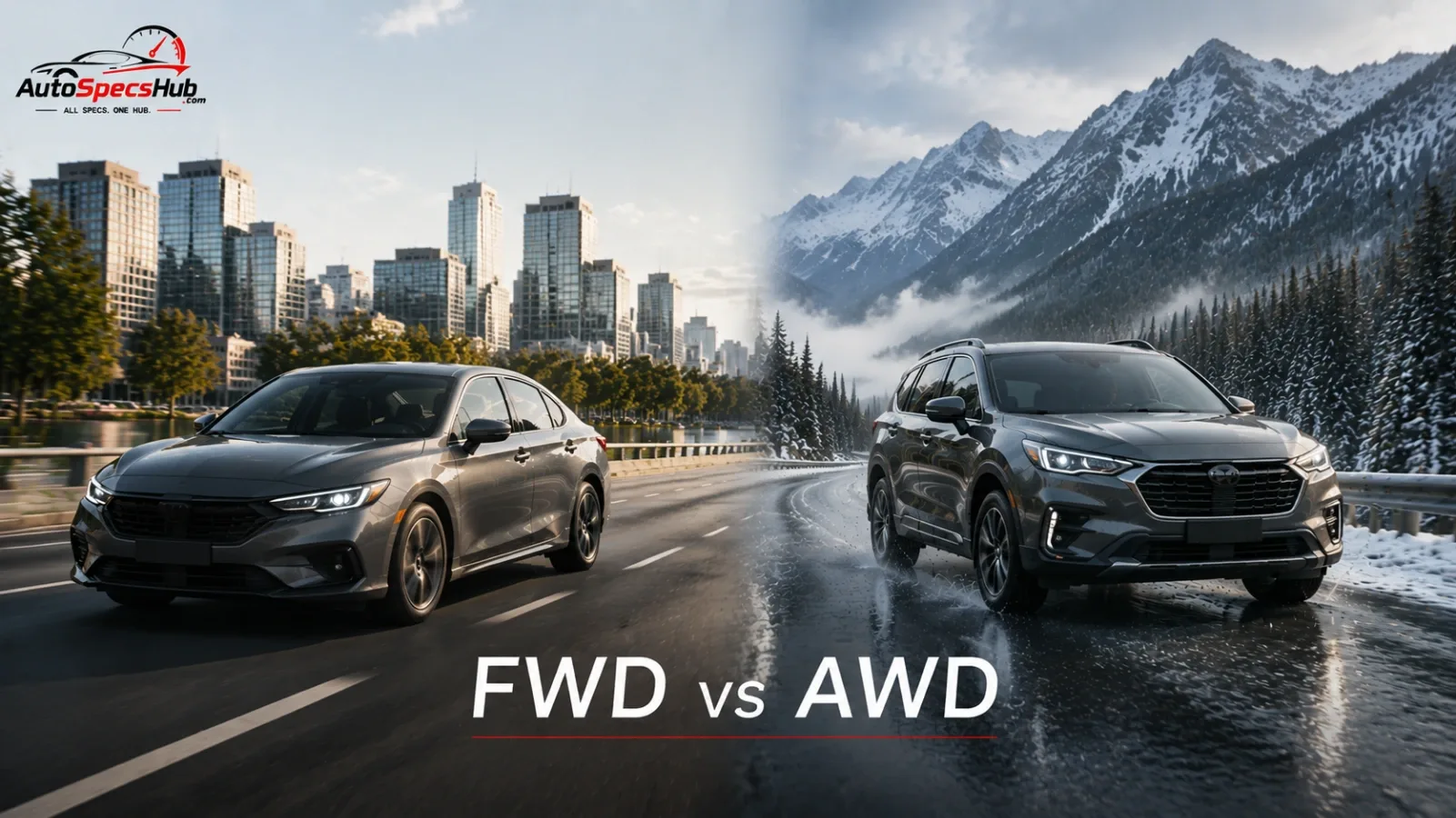
Choosing between FWD and AWD depends on how and where you drive. Front-wheel drive (FWD) is usually more efficient, affordable, and practical for everyday city and highway driving, while all-wheel drive (AWD) can provide additional traction on snow, rain, gravel, and other slippery surfaces.
Neither drivetrain is automatically better for every driver. FWD can offer lower purchase, fuel, and maintenance costs, while AWD may be worth the extra cost if you regularly encounter challenging road conditions or want additional traction.
What Is a Drivetrain?
A drivetrain is the system that transfers power from the engine or electric motor to the wheels. It includes components such as the transmission, differentials, axles, and other mechanical parts responsible for delivering power to the road.
The drivetrain affects traction, fuel efficiency, handling characteristics, maintenance requirements, and driving performance.
In simple terms:
The engine creates power, but the drivetrain decides how that power reaches the road.
In a front-wheel-drive vehicle, power is sent to the front wheels. In an all-wheel-drive vehicle, power can be distributed between all four wheels.
What Is Front-Wheel Drive (FWD)?
Front-wheel drive means the engine sends power only to the front wheels. The front tires are responsible for both moving the vehicle and helping with steering.
FWD is one of the most common drivetrain layouts because it provides a practical balance of efficiency, affordability, and everyday usability.
It is commonly found in:
Compact cars
Sedans
Hatchbacks
Small crossovers
Examples of popular FWD vehicles include the Honda Civic, Toyota Corolla, and Hyundai Elantra.
How Does FWD Work?
In a FWD vehicle, power travels from the engine through the transmission and differential before reaching the front wheels.
The front wheels perform two main functions:
Deliver power to move the vehicle
Control the direction of travel
Because the drivetrain components are located mainly at the front, manufacturers can create efficient vehicle designs with more interior space.
Advantages of FWD
Better Fuel Economy
One of the biggest advantages of FWD is efficiency.
FWD systems are usually lighter and less complex than AWD systems because they do not require additional components to power the rear wheels.
This can result in:
Lower fuel consumption
Reduced running costs
Better efficiency for daily commuting
For drivers who mainly travel on highways and city roads, FWD can be a practical choice.
Lower Purchase and Maintenance Costs
FWD vehicles are generally less expensive because the drivetrain design is simpler.
Compared with AWD systems, FWD usually has:
Fewer mechanical components
Lower repair complexity
Reduced maintenance costs
This makes FWD attractive for buyers who want affordable long-term ownership.
More Interior Space
The simpler layout of FWD allows manufacturers to use space more efficiently.
Benefits can include:
More passenger room
Better cargo packaging
Practical cabin layouts
This is one reason why many family cars and compact vehicles use FWD.
Disadvantages of FWD
Less Traction in Difficult Conditions
FWD vehicles perform well in normal conditions, but traction can become more limited on slippery surfaces.
Examples include:
Heavy snow
Ice
Mud
Loose roads
Because the front wheels handle both steering and acceleration, they can become overloaded when additional grip is needed.
However, a FWD vehicle with quality tires can still perform well in many weather conditions.
Limited Performance Capability
During hard acceleration, the front tires must manage both steering and power delivery.
This can reduce performance compared with vehicles that distribute power across more wheels.
For everyday driving, this is usually not a problem. For performance-focused vehicles, other drivetrain layouts may be preferred.
What Is All-Wheel Drive (AWD)?
All-wheel drive means power can be delivered to all four wheels instead of only the front wheels. Unlike FWD, AWD systems can adjust power distribution between the front and rear axles depending on traction conditions.
AWD is commonly available in:
SUVs
Crossovers
Luxury vehicles
Performance cars
Examples include Subaru Outback models, Toyota RAV4 AWD versions, and many Audi vehicles equipped with all-wheel-drive systems.
Modern AWD systems use electronic sensors and control systems to monitor wheel movement and road conditions. This allows the vehicle to respond quickly when traction changes.
How Does AWD Work?
An AWD system uses additional drivetrain components to transfer power between the front and rear wheels.
Depending on the vehicle design, AWD can:
Continuously send power to all four wheels
Transfer more power to wheels with better grip
Adjust power delivery automatically based on driving conditions
When the system detects wheel slip, it can redirect power to improve traction.
However, AWD is mainly designed to improve acceleration and grip. It does not replace good tires, careful driving, or proper braking technique.
Advantages of AWD
Improved Traction
The biggest advantage of AWD is improved traction.
Because all four wheels can receive power, AWD vehicles can reduce wheel slip during acceleration.
This can be helpful in:
Snow
Rain
Gravel roads
Uneven surfaces
For drivers who regularly experience changing weather conditions, AWD can provide additional confidence.
Better Control in Changing Weather
AWD can help maintain traction when road conditions become unpredictable.
It can be useful for drivers who regularly deal with:
Winter weather
Heavy rainfall
Mountain roads
Rural routes
However, AWD does not automatically make a vehicle safer in every situation. Tires remain one of the most important factors affecting grip and stopping ability.
The tires are still the only connection between the vehicle and the road.
Better Suitability for SUVs
Many SUVs use AWD because larger vehicles can benefit from additional traction.
Drivers who choose SUVs for:
Family travel
Outdoor activities
Longer trips
Mixed road conditions
may find AWD useful.
For example, many modern SUVs offer AWD options to improve confidence in different environments.
Disadvantages of AWD
Higher Purchase Cost
AWD vehicles usually cost more because the system requires additional components.
The price difference depends on the vehicle model, manufacturer, and available equipment.
For buyers focused on affordability, a FWD version may provide better value.
Lower Fuel Efficiency
AWD systems add weight and mechanical complexity.
As a result, AWD versions usually consume slightly more fuel than comparable FWD models.
The difference varies depending on:
Vehicle size
Engine type
AWD system design
Driving habits
Higher Maintenance Costs
Because AWD systems include additional components, maintenance can be more expensive over time.
Extra components may include:
Rear differentials
Transfer components
Additional drivetrain hardware
This does not mean AWD vehicles are unreliable, but they generally have more parts that require maintenance.
FWD vs AWD: Key Differences
Category | FWD | AWD |
Power delivery | Front wheels only | Power can reach all four wheels |
Fuel economy | Usually better | Usually lower |
Purchase price | Usually lower | Usually higher |
Maintenance | Simpler system | More complex system |
Snow performance | Good with proper tires | Better traction advantage |
Daily driving | Excellent | Excellent |
Off-road ability | Limited | More capable |
FWD vs AWD: Which Is Better?
Neither FWD nor AWD is automatically better. FWD is usually the better choice for everyday city and highway driving because it generally offers lower purchase costs, better fuel economy, and simpler maintenance. AWD can be the better choice for drivers who regularly encounter snow, rain, gravel, or other slippery conditions where additional traction is useful.
For most drivers in mild climates, FWD can provide everything they need. If you frequently drive in challenging conditions, AWD may be worth the additional cost. Good tires remain important with either drivetrain.
FWD vs AWD in Snow
AWD can provide an advantage when accelerating on snow or other slippery surfaces by helping reduce wheel slip. However, FWD can also perform well in snow with appropriate tires. AWD does not automatically shorten braking distances, so tire grip remains critical.
AWD vs 4WD: What Is the Difference?
Many buyers confuse AWD with four-wheel drive (4WD), but they are designed for different purposes.
AWD
All-wheel drive is mainly designed for everyday driving.
It:
Works automatically
Adjusts power distribution when needed
Improves traction on changing road surfaces
AWD is common in modern SUVs, crossovers, luxury vehicles, and performance cars.
4WD
Four-wheel drive is generally designed for more demanding conditions.
It:
Is often selectable by the driver
Is built for rugged terrain
Is common in trucks and dedicated off-road vehicles
Drivers who frequently travel on difficult trails, deep mud, or challenging terrain may prefer 4WD.
For many everyday SUV and crossover drivers, AWD can be the more convenient choice when additional traction is useful, while 4WD is generally better suited to demanding off-road conditions.
Is AWD Worth the Extra Cost?
AWD can be worth paying extra for, but it depends on how and where you drive.
AWD may be a good choice if you:
Live in an area with frequent snow
Drive on slippery roads regularly
Experience changing weather conditions
Need additional SUV capability
However, many buyers choose AWD without considering whether they actually need it.
If you mainly drive in cities, suburbs, or mild climates, FWD may be the smarter option because it can offer:
Lower purchase cost
Better fuel economy
Lower maintenance expenses
A FWD vehicle with quality tires can often perform better than an AWD vehicle with poor tires in certain conditions.
FWD vs AWD: Which One Should You Choose?
The best drivetrain depends on your lifestyle, location, and driving habits.
Choose FWD If You Want:
Better fuel efficiency
Lower ownership costs
Affordable maintenance
Simple and reliable transportation
Mostly city and highway driving
FWD is a practical choice for many commuters, families, and everyday drivers.
Choose AWD If You Want:
Better traction in poor weather
More confidence on slippery roads
Additional SUV capability
Improved grip during acceleration
AWD is especially useful for drivers who regularly face snow, rain, or changing road conditions.
Popular Vehicle Types With FWD and AWD
Different vehicle categories commonly use different drivetrain systems.
Vehicles Commonly Available With FWD:
Compact cars
Sedans
Hatchbacks
Many hybrid vehicles
Examples include vehicles such as the Honda Civic, Toyota Corolla, and Hyundai Elantra.
Vehicles Commonly Available With AWD:
SUVs
Crossovers
Luxury vehicles
Performance models
Examples include Subaru Outback, Toyota RAV4 AWD, and Audi models with AWD systems.
When comparing vehicles, always check the drivetrain specification because some models are available with multiple drivetrain options.
AutoSpecsHub provides detailed vehicle information, including drivetrain, performance, dimensions, and other specifications, helping buyers compare different models before making a decision.
Frequently Asked Questions
Is AWD better than FWD?
AWD provides better traction in certain situations, especially when roads are slippery. However, FWD is usually more affordable, efficient, and suitable for many everyday drivers.
Does AWD use more fuel than FWD?
Yes. AWD vehicles generally use slightly more fuel because the system adds extra weight and mechanical components.
Is FWD good for snow?
Yes. A FWD vehicle with quality winter tires can perform well in snow. AWD mainly provides an advantage during acceleration by helping reduce wheel slip.
Do I need AWD for normal driving?
Most drivers do not need AWD for normal city and highway driving. FWD is often enough unless you regularly experience severe weather or difficult road conditions.
Does AWD improve braking?
No. AWD mainly improves traction during acceleration and helps reduce wheel slip. It does not significantly shorten braking distances because stopping performance depends on factors such as tires, brakes, road conditions, and vehicle weight.
Final Thoughts
Choosing between FWD and AWD is not about finding a drivetrain that is always better. It is about choosing the system that matches your driving needs.
FWD offers efficiency, affordability, and simple ownership, making it a strong option for many drivers. AWD provides additional traction and confidence for people who regularly deal with snow, rain, or changing road conditions.
Before buying a vehicle, consider your climate, driving habits, budget, and long-term ownership costs.
The best drivetrain is the one that provides the capability you actually need.
Compare vehicle specifications, drivetrain options, and performance details on AutoSpecsHub to find the right vehicle for your lifestyle.