
What Type of Transmission Fluid Does a Land Rover Defender Use? Types, Capacity, and Change Guide
Find the correct Land Rover Defender transmission fluid, understand refill capacity, recognize warning signs, and learn how modern ZF automatic transmissions are serviced.
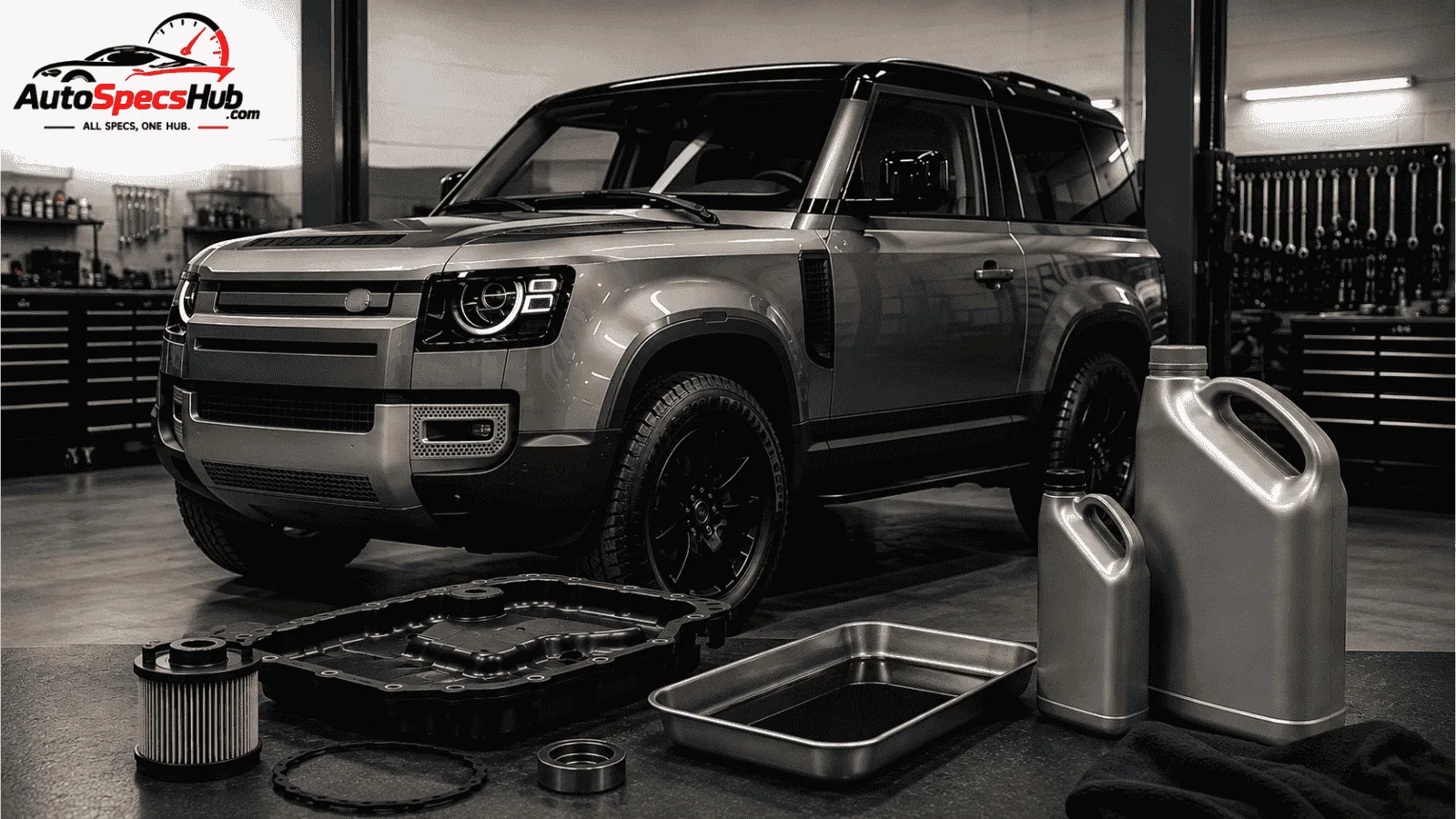
Transmission fluid plays a major role in how smoothly a Land Rover Defender changes gears and how effectively its automatic transmission manages friction, heat, and wear. It lubricates internal components, creates hydraulic pressure, and protects the gearbox during everyday driving, towing, long-distance travel, and off-road use.
However, not every Defender uses the same fluid. The correct product depends on the model year, engine, transmission version, and market.
This guide primarily covers the modern Land Rover Defender introduced for the 2020 model year, including Defender 90, Defender 110, and Defender 130 models equipped with ZF eight-speed automatic transmissions.
For many compatible modern Defender applications, the specified product is ZF LifeguardFluid 8 or the corresponding Land Rover-approved fluid commonly identified by part number LR023288. The exact specification should always be confirmed through the vehicle identification number before fluid or service parts are purchased.
Older and classic Defender models may use different manual or automatic gearboxes with completely separate lubricant requirements.
Quick Answer: What Transmission Fluid Does a Land Rover Defender Use?
Many modern Land Rover Defender models with compatible ZF eight-speed automatic transmissions use ZF LifeguardFluid 8 or the equivalent Land Rover-approved transmission fluid commonly identified as LR023288.
The correct fluid cannot be selected by vehicle name alone. Confirm the model year, engine, exact transmission version, market, and current part number through the VIN or official service information.
Fluid capacity also depends on the type of service being performed. A simple drain and refill requires less fluid than a pan-and-filter service, while a completely dry transmission requires a larger quantity.
What Is Transmission Fluid?
Transmission fluid is a specially formulated lubricant used inside an automatic gearbox. A modern automatic transmission contains gears, bearings, clutch packs, valves, a torque converter, a fluid pump, and electronically controlled hydraulic components.
The fluid forms a protective layer between moving surfaces, helping reduce friction and limit wear on shafts, gears, bearings, and clutch components. When the level is too low or the fluid has deteriorated, internal heat and friction may increase.
Transmission fluid also performs several other essential functions.
Hydraulic Control
Modern automatic transmissions use pressurized fluid to apply and release internal clutch packs. The transmission control system decides when a gear change should occur, while hydraulic pressure physically carries out the shift.
Fluid with the wrong viscosity or friction characteristics may contribute to:
Harsh gear changes
Delayed engagement
Gear slipping
Hesitation
Inconsistent shifting
Abrupt clutch engagement
Even a high-quality synthetic fluid may cause poor operation if it does not meet the exact transmission specification.
Heat Management
Transmission fluid absorbs heat from internal components and transfers it toward the cooling system. Temperatures can rise considerably during:
Trailer towing
Long hill climbs
Heavy-load driving
Deep-sand travel
Low-speed off-road driving
Stop-and-go traffic
Hot-weather operation
A Defender used for towing or slow off-road travel may place considerably more thermal stress on its transmission than one driven mainly on open roads.
Cleaning and Internal Protection
Approved transmission fluids contain additives designed to control oxidation, deposits, corrosion, and foaming. These additives are developed around the requirements of a particular gearbox.
The correct specification is therefore more important than brand popularity, packaging, price, or a general claim that the fluid is suitable for European vehicles.
Types of Transmission Fluid for the Land Rover Defender
Automatic transmission fluids are not universally interchangeable. The term “automatic transmission fluid” describes a broad product category rather than one fluid that works in every gearbox.
ZF LifeguardFluid 8
ZF LifeguardFluid 8 is designed for compatible ZF 8HP automatic transmissions. For many modern Defender applications, it is the main reference product.
ZF developed the fluid around the viscosity, lubrication, hydraulic-control, friction, and shift-quality requirements of its eight-speed gearboxes. It is commonly identified by product number S671 090 312.
Using the correct fluid helps the transmission maintain suitable hydraulic pressure and controlled clutch engagement. An incompatible product may alter shift behavior even when marketed as a premium or fully synthetic automatic transmission fluid.
Land Rover LR023288
LR023288 is a Land Rover transmission-fluid part number associated with compatible ZF eight-speed automatic transmissions.
A genuine Land Rover container may display this part number instead of the ZF product name. The key question is whether the fluid is approved for the exact gearbox installed in the vehicle.
Part numbers and approved replacements may change. A Land Rover dealer or knowledgeable parts supplier should use the VIN to verify the current product before it is ordered.
Approved Aftermarket Transmission Fluids
Some aftermarket products claim compatibility with:
ZF LifeguardFluid 8
ZF 8HP automatic transmissions
Land Rover LR023288
Selected Jaguar Land Rover gearboxes
An aftermarket product may be suitable when its technical documentation clearly identifies the required ZF or Land Rover specification.
Broad statements such as “European ATF,” “multi-vehicle fluid,” or “suitable for eight-speed transmissions” are not enough on their own.
The safest options are:
Genuine Land Rover fluid confirmed through the VIN
The correct ZF LifeguardFluid product
A properly documented equivalent that clearly lists the required approval
Transmission fluid should not be selected only by price, brand reputation, packaging, or an unsupported compatibility claim.
Fluids That Should Not Be Used
A modern Defender automatic transmission does not use standard CVT fluid, dual-clutch transmission fluid, differential oil, or transfer-case oil.
Fluid type | Intended use | Suitable for the Defender transmission? |
|---|---|---|
ZF LifeguardFluid 8 | Compatible ZF 8HP transmissions | Yes, when confirmed |
Land Rover LR023288 | Compatible Land Rover ZF applications | Yes, when confirmed by VIN |
Approved equivalent | Matching ZF or Land Rover specification | Only after verification |
CVT fluid | Continuously variable transmissions | No |
DCT fluid | Dual-clutch transmissions | No |
Differential oil | Front or rear differentials | No |
Transfer-case oil | Transfer case | No |
The transmission, transfer case, and differentials are separate drivetrain systems. Each requires its own lubricant.
An oil approved for one component should never be assumed suitable for another.
Land Rover Defender Transmission Fluid Capacity
There is no single transmission-fluid capacity that applies to every Defender. The amount required depends on:
Model year
Engine
Transmission version
Service procedure
Amount of fluid removed
Whether internal components were replaced
Whether the gearbox is partially or completely empty
Drain and Refill
A basic drain and refill removes only the fluid that flows out through the drain opening.
A considerable amount may remain inside:
The torque converter
Valve body
Transmission cooler
Cooler lines
Hydraulic passages
Internal clutch assemblies
The drain-and-refill quantity is therefore lower than the transmission’s total dry capacity.
Pan-and-Filter Service
Many ZF eight-speed transmissions use a pan with an integrated filter. A more complete service may include:
A replacement transmission pan
A new integrated filter
Replacement seals
New bolts
New drain and fill plugs
Approved transmission fluid
Some ZF oil-change kits include seven one-liter containers of LifeguardFluid. That does not mean every Defender requires exactly seven liters.
The technician must follow the procedure for the specific gearbox and set the final fluid level accurately.
Dry Fill
A dry fill is required when the transmission has been rebuilt, replaced, or completely emptied.
In this situation, the torque converter, cooler, lines, valve body, and internal passages may all be empty. The gearbox therefore requires more fluid than it would during routine maintenance.
Using a dry-fill quantity after a simple drain and refill may overfill the transmission.
Problems Caused by Too Little Fluid
An insufficient fluid level may contribute to:
Low hydraulic pressure
Poor internal lubrication
Delayed engagement
Transmission overheating
Gear slipping
Accelerated internal wear
Inconsistent shifting
Problems Caused by Too Much Fluid
Overfilling may lead to:
Fluid foaming
Aeration
Fluid leaks
Rough shifting
Incorrect internal pressure
Overheating
Fluid being forced through seals or vents
Capacity should be treated as a service reference rather than a fixed amount to pour into every Defender. The final level must be checked through the correct ZF or Land Rover temperature-based procedure.
How to Confirm the Correct Defender Transmission Fluid
The exact vehicle and gearbox should be identified before fluid, filters, pans, or seals are ordered.
Confirm the Defender Generation
This guide mainly applies to modern Defender models introduced for the 2020 model year. Older Defender vehicles may use different manual or automatic transmissions with unrelated lubricant requirements.
Drivers comparing generations, engines, dimensions, and drivetrain configurations can review the available Land Rover Defender specifications before confirming the gearbox through the VIN, transmission label, or service records.
Confirm the Model and Engine
Defender 90, Defender 110, and Defender 130 models have been offered with different powertrains depending on model year and market, including:
Gasoline engines
Diesel engines
Mild-hybrid systems
Plug-in hybrid systems
V8 engines
Two vehicles may both use eight-speed automatic transmissions while having different gearbox variants, calibration, service parts, or fluid requirements.
Use the VIN
The vehicle identification number is one of the most reliable ways to verify the correct fluid and service components.
A Land Rover dealer or experienced parts supplier may use the VIN to identify:
The exact transmission version
The current transmission-fluid part number
The correct pan and filter
Required seals and plugs
Updated or superseded components
A qualified workshop may also identify the gearbox through diagnostic software, official service information, or the identification label attached to the transmission.
Read the Technical Data Sheet
Do not rely only on the front label or the word “synthetic.”
The fluid manufacturer’s technical information should clearly identify compatibility with the required ZF or Land Rover specification.
A product described only as suitable for luxury SUVs, European vehicles, or eight-speed transmissions may not meet the Defender gearbox’s requirements.
Do Not Rely on Fluid Color
Fluid color is not a reliable method of identifying the correct product.
Different fluids may look similar while having different:
Viscosity characteristics
Additive packages
Friction properties
Temperature performance
Hydraulic behavior
Transmission fluid may also become darker as it ages. Dark fluid alone does not prove that it has failed, nor does it identify the original specification.
Avoid mixing an approved product with an unknown fluid. Some old fluid will remain after a normal drain and refill, but the replacement product should meet the same required specification.
When Should Defender Transmission Fluid Be Changed?
The official maintenance schedule for the exact vehicle should be the first reference.
ZF describes its transmission fluid as a long-life product, but it also recommends an oil change at around 150,000 kilometers, or approximately 93,000 miles, for many applications.
Earlier servicing may be sensible when the transmission is frequently exposed to heavy loads, elevated temperatures, or severe operating conditions.
More frequent attention may be appropriate for a Defender regularly used for:
Trailer towing
Mountain driving
Commercial work
Heavy cargo
Frequent off-road travel
Deep sand or mud
Long periods of low-speed operation
Hot climates
Repeated short journeys
Stop-and-go traffic
Mileage should not be the only consideration. Vehicle age, maintenance history, leaks, driving conditions, and transmission behavior also matter.
A fluid change is preventive maintenance. It cannot repair damaged bearings, worn clutch packs, faulty sensors, a failing valve body, or other internal defects.
Warning Signs That the Transmission Needs Attention
Transmission symptoms should not be ignored. However, they do not always prove that the fluid is old or that replacing it will solve the problem.
Delayed Engagement
Delayed engagement occurs when there is a noticeable pause after selecting Drive or Reverse.
Possible causes include:
Low fluid
An incorrect fluid level
Hydraulic-pressure loss
Control-system faults
Valve-body problems
Internal wear
The vehicle should be inspected when it requires additional engine speed or a long delay before it begins moving.
Rough Gear Changes
Rough shifting may appear as:
Sudden jolts
Harsh upshifts
Rough downshifts
Hesitation
Inconsistent gear changes
Abrupt engagement
Fluid condition is one possible cause, but software, sensors, adaptation values, clutch wear, and valve-body faults may create similar symptoms.
Shuddering or Vibration
Shuddering during acceleration or a gear change may involve the transmission or torque converter.
However, vibration may also come from:
Tires
Wheels
Driveshafts
Engine mounts
Transmission mounts
Suspension components
The cause should be diagnosed before a transmission-fluid service is assumed to be the solution.
Gear Slipping
Gear slipping may feel as though engine speed increases without a matching increase in vehicle speed.
Possible causes include:
Low hydraulic pressure
An incorrect fluid level
Damaged clutch packs
Valve-body faults
Internal transmission damage
Continuing to drive with a slipping transmission may create additional heat and internal wear.
Overheating
An overheating transmission may produce:
A dashboard warning
A hot or burnt odor
Reduced performance
Abnormal shifting
Protective or restricted operation
Possible causes include low fluid, overfilling, cooling-system faults, incorrect fluid, or internal damage.
Fluid Leaks
Transmission-fluid leaks should be inspected promptly.
Oil near the middle of the vehicle may come from:
The transmission pan
Pan seals
Cooler lines
Shaft seals
The transfer case
Another drivetrain component
Repeatedly topping up the transmission without repairing the source of the leak is not a proper solution.
Burnt Smell or Contamination
A burnt odor, visible metal particles, or heavy contamination should be investigated professionally.
Dark fluid alone does not automatically indicate transmission failure. Its condition should be evaluated together with:
Mileage
Vehicle age
Maintenance records
Smell
Shift quality
Diagnostic fault codes
Visible debris
Drain and Fill vs. Transmission Flush
A drain and fill removes part of the old transmission fluid and replaces it with fresh approved fluid.
A pan-and-filter service may remove more fluid while also replacing the filter, seals, and related service parts.
A transmission flush or fluid exchange replaces a larger percentage of the old fluid using specialized equipment.
When a Drain and Fill May Be Suitable
For a properly maintained gearbox, a controlled pan-and-filter service using the correct refill procedure is often a sensible maintenance approach.
It allows the technician to:
Inspect the old fluid
Examine the transmission pan
Replace the filter
Check for internal debris
Renew seals and plugs
Refill with approved fluid
Set the level accurately
When a Flush Requires Caution
A transmission flush or exchange should be approached carefully when:
The maintenance history is unknown
The transmission already slips
The old fluid is heavily contaminated
Internal damage may be present
The equipment contains an unapproved fluid
Unapproved cleaning additives are being proposed
Any service equipment used must contain the correct approved fluid and should not introduce incompatible additives.
Neither a drain and fill nor a flush is a guaranteed repair for a failing gearbox. Existing symptoms should be diagnosed before service work is performed.
Can You Change Defender Transmission Fluid at Home?
An experienced person may be able to service the transmission at home, but the procedure involves more than simply draining and adding fluid.
The job may require:
A level vehicle lift
Suitable safety equipment
Diagnostic software
Fluid-temperature monitoring
Correct filling tools
Approved transmission fluid
The correct pan and filter
Replacement seals and bolts
Model-specific instructions
A torque wrench
The vehicle generally needs to remain level while the transmission is filled. The fluid level must also be checked within the correct temperature range.
An inaccurate level can cause poor shifting, overheating, aeration, or internal wear. For most owners, a Land Rover specialist or a workshop experienced with ZF transmissions is the safer option.
Frequently Asked Questions
What transmission fluid does a modern Land Rover Defender use?
Many modern Defender models with compatible ZF eight-speed automatic transmissions use ZF LifeguardFluid 8 or the corresponding Land Rover-approved fluid commonly identified as LR023288. Confirm the exact product through the VIN before purchasing it.
How much transmission fluid does a Defender need?
The amount depends on the gearbox and service type. A basic drain and refill requires less fluid than a pan-and-filter service, while a completely dry transmission requires more. The final level must be set through the correct procedure.
Can I use universal automatic transmission fluid?
A universal product should not be used unless its technical documentation clearly confirms compatibility with the exact ZF or Land Rover specification required by the vehicle. Broad marketing claims are not sufficient.
Is Land Rover transmission fluid really lifetime fluid?
Some manufacturers describe transmission fluid as long-life or lifetime fluid, but its condition still changes with heat, age, load, and driving conditions. Earlier service may be appropriate when the Defender is regularly used under severe conditions.
Will changing the fluid fix rough shifting?
Fresh approved fluid may help when old, low, or incorrect fluid is contributing to the problem. However, rough shifting may also result from software, sensors, adaptation values, valve-body faults, worn clutch packs, or internal damage. Diagnosis should come first.
Should the transmission be flushed?
A flush is not automatically better than a drain-and-fill or pan-and-filter service. Caution is required when maintenance history is unknown or the gearbox already has symptoms.
Can transmission-fluid color identify the correct product?
No. Fluids with similar colors may use different viscosity levels, friction properties, and additive packages. Always verify the required specification instead of choosing fluid by appearance.
Conclusion
Many modern Land Rover Defender models use ZF eight-speed automatic transmissions. For compatible applications, the correct fluid is often ZF LifeguardFluid 8 or the corresponding Land Rover-approved product commonly identified as LR023288.
The Defender name alone is not enough to select the correct fluid. Confirm the model year, engine, market, exact gearbox, and current part number through the VIN before buying fluid or service components.
Capacity also varies according to the work being performed. A basic drain and refill requires less fluid than a pan-and-filter replacement, while a completely dry transmission needs a larger quantity. The final level must be set through the correct temperature-based procedure rather than estimated.
Delayed engagement, rough shifting, slipping, shuddering, overheating, leaks, burnt odors, and transmission warnings should be diagnosed before assuming that a fluid change will solve the problem.
Using approved fluid, the correct service parts, and an accurately set level can help the gearbox operate smoothly during daily driving, towing, long journeys, and off-road use. Owners comparing related vehicles can also review other Land Rover models and specifications before planning maintenance for a particular model.