
BMW X5 Towing Capacity Explained: What You Need to Know
BMW X5 towing capacity reaches 7,200 pounds for 2026 when properly equipped. See how the X5 handles towing, from trailer weight and tongue weight to hitch equipment, braking, and choosing the right configuration.
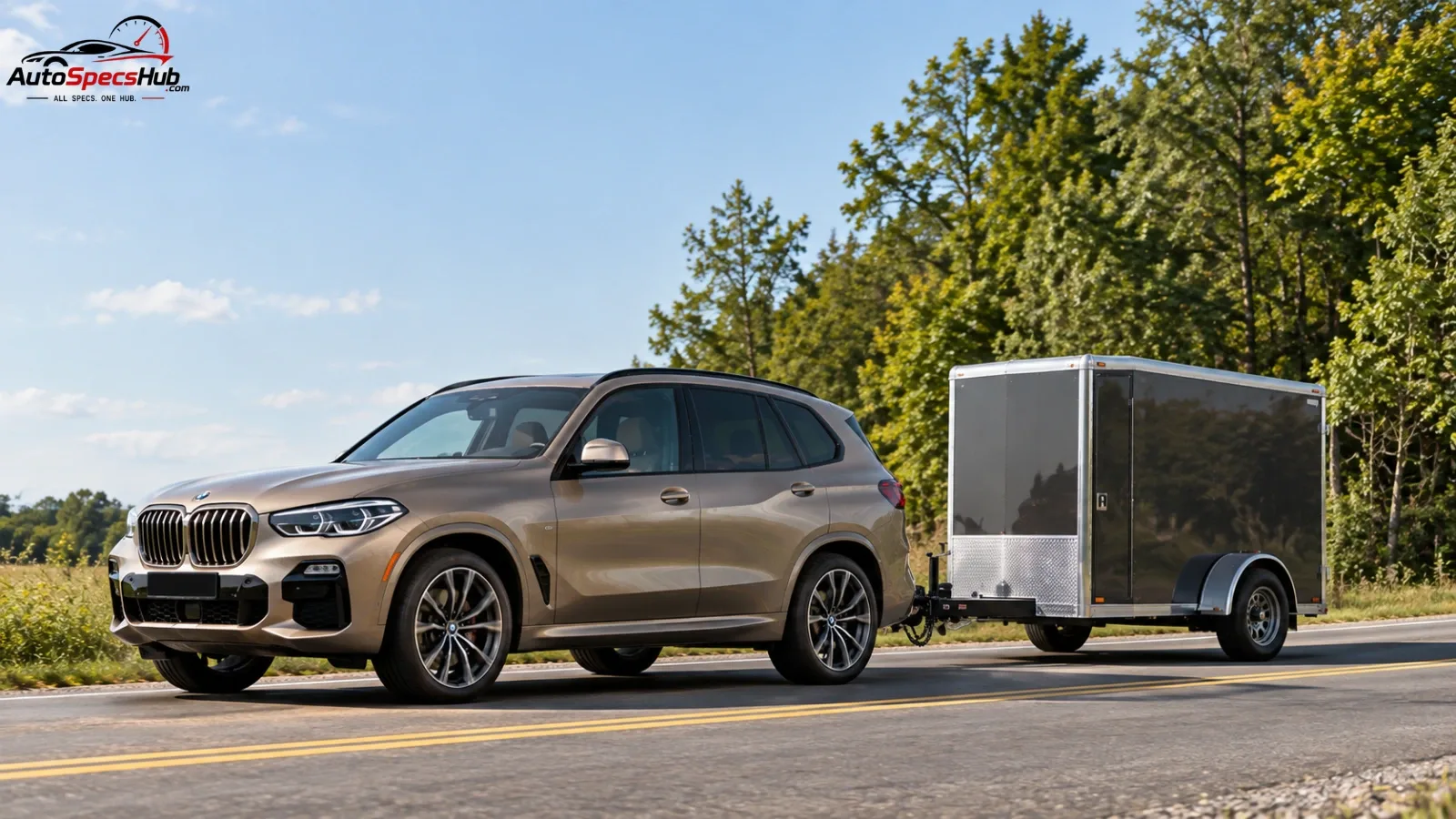
The BMW X5 is better known for luxury and performance than towing, but it has serious capability when properly equipped. For 2026, the X5 can tow up to 7,200 pounds with the available factory-installed trailer hitch, giving it enough capacity for many boats, utility trailers, and recreational loads.
The important question is whether that maximum applies to the X5 you're considering and what else you need to account for before towing. The vehicle's configuration, hitch equipment, trailer weight, tongue weight, passengers, cargo, and braking system all matter.
Here's what to know about the BMW X5 towing capacity before choosing one for regular or occasional towing.
The 2026 BMW X5's 7,200-Pound Rating
BMW gives the 2026 X5 a maximum towing capacity of 7,200 pounds with the available factory-installed trailer hitch. That figure applies to the current U.S.-market X5 and gives the luxury SUV considerably more towing ability than its premium positioning might suggest.
The 2026 lineup includes the X5 sDrive40i, X5 xDrive40i, X5 xDrive50e plug-in hybrid, and X5 M60i.
The key point is that 7,200 pounds is a maximum rating, not a recommended target for every trip. A trailer weighing 3,500 or 4,000 pounds will place very different demands on the X5 than one approaching the upper limit.
For a buyer, the number is best viewed as the ceiling for a properly equipped vehicle. Your actual trailer, passengers, cargo, and towing conditions determine how much of that capacity you should realistically use.
Which X5 Makes the Most Sense for Towing?
BMW gives buyers several different approaches to the X5, and choosing between them isn't simply a matter of selecting the engine with the most horsepower.
The X5 sDrive40i uses a 3.0-liter turbocharged inline-six producing 375 horsepower and drives the rear wheels. The X5 xDrive40i uses the same 375-hp engine with all-wheel drive. The plug-in hybrid X5 xDrive50e combines a six-cylinder engine with an electric motor for 483 horsepower. BMW also offers the V8-powered X5 M60i.
For occasional towing, the 40i models already provide substantial performance. The xDrive40i can be particularly attractive if towing involves wet ramps, loose surfaces, or other situations where additional traction is useful.
The xDrive50e is aimed at buyers who want plug-in hybrid capability alongside strong performance, while the M60i is much more performance-oriented.
In other words, more horsepower does not automatically mean a better towing choice. The right X5 depends on how much you tow, where you tow, and what you want the SUV to do when the trailer is disconnected.
The Factory Hitch Changes the Equation
The factory-installed trailer hitch deserves particular attention because BMW specifically connects the 7,200-pound maximum to that equipment.
This is especially important if you're looking at a used X5.
Don't assume that every X5 has the same towing equipment simply because it carries the same model badge. If towing is a major reason you're buying the vehicle, verify that the particular X5 has the appropriate factory equipment and check its documentation before purchasing.
BMW's guidance also emphasizes using appropriately rated towing equipment and a trailer with appropriate braking.
That distinction is important because attaching a hitch to an SUV does not, by itself, establish that the vehicle has the manufacturer's maximum towing capability.
What Can You Actually Tow With an X5?
A 7,200-pound maximum opens up a broad range of possibilities, but the trailer's loaded weight is what matters.
A trailer might look relatively small when empty but become substantially heavier once equipment, fuel, water, tools, or recreational gear is added. The same principle applies to boats, powersports trailers, utility trailers, and other loads.
Depending on their actual loaded weights, an appropriately equipped X5 can potentially be used for:
Boat trailers
Personal watercraft trailers
Utility trailers
Equipment trailers
Motorcycle and powersports trailers
Some horse trailers
Recreational trailers
The trailer's category alone doesn't determine whether the X5 can tow it.
For example, two boat trailers can have dramatically different weights depending on the boat being carried. A utility trailer loaded with machinery can also weigh far more than its empty specification suggests.
Before towing, establish the actual ready-to-travel weight of the complete trailer and compare it with the limits for your particular X5.
Trailer Weight Isn't the Only Number to Watch
One of the biggest mistakes in towing is focusing entirely on the trailer's total weight.
The trailer also places a downward load on the X5 through the hitch. That's tongue weight, and it contributes to the load being carried by the vehicle.
Passengers and luggage add to that load as well.
So, even if a trailer is below the X5's maximum towing rating, you still need to account for the people inside the SUV, cargo in the vehicle, hitch equipment, and the applicable vehicle weight limits.
BMW states that permissible trailer load, axle load, tongue weight, and permissible gross vehicle weight are specified in the vehicle's technical data.
That means a proper towing calculation involves more than asking whether the trailer is under 7,200 pounds.
The entire combination needs to remain within its applicable limits.
Braking Becomes More Important With Heavy Trailers
Pulling a trailer is only half the job. Stopping it is equally important.
BMW recommends using a trailer with appropriate braking and notes that aftermarket trailer brakes may be required in some states.
As trailer weight increases, relying entirely on the SUV's brakes becomes less desirable. Proper trailer brakes allow the trailer to contribute to stopping and can make a heavy combination easier to control.
The exact legal requirements vary by location, so owners should check the rules that apply where they will be towing.
Even when a particular setup is legally permitted, appropriate braking equipment is an important part of making a heavy trailer easier to manage.
xDrive Helps Traction, Not the Tow Rating
The difference between sDrive and xDrive is worth understanding if you're choosing an X5 specifically for towing.
The sDrive40i uses rear-wheel drive, while the xDrive40i, xDrive50e, and M60i use BMW's all-wheel-drive system.
xDrive can be helpful when pulling away on a wet boat ramp or traveling on slippery roads because additional traction can help the vehicle put its available power onto the surface.
It does not, however, increase the X5's published towing capacity.
If you're interested in how drivetrain layouts differ more generally, FWD vs AWD comparison explains the practical differences between these systems.
For the X5, think of AWD as a traction advantage rather than an additional towing allowance.
The X5 Has an Advantage When the Trailer Is Gone
One reason the X5 works well as an occasional tow vehicle is that towing isn't its only purpose.
The 2026 X5 remains a midsize luxury SUV with substantial passenger and cargo capability. BMW lists 33.9 cubic feet of cargo space behind the second row and 72.3 cubic feet with the seats folded for the sDrive40i and xDrive40i. The xDrive50e provides 33.0 cubic feet behind the second row and 71.2 cubic feet with the seats folded.
That makes the X5 useful throughout the week rather than only when a trailer is attached.
You can commute in it, take the family on a road trip, carry luggage, and enjoy its performance without driving a large truck-based vehicle every day.
That's where the X5's towing ability becomes particularly appealing. It offers substantial capacity without making towing the defining characteristic of the vehicle.
When the X5 Is the Better Alternative to a Pickup
For occasional towing, the X5 can make more sense than buying a vehicle designed primarily around heavy-duty work.
If you tow a boat several times a year, use a utility trailer occasionally, or carry recreational equipment, the X5 gives you meaningful towing capability while remaining comfortable and refined during everyday driving.
A pickup becomes more compelling when towing is frequent, the loads are consistently heavy, or the vehicle is being used for work.
That's where a purpose-built truck's greater capacity and work-oriented design can outweigh the X5's luxury and road-going advantages.
For comparison, a Toyota Tacoma towing capacity article can help put the X5's luxury-SUV approach alongside a pickup designed with towing and utility work much higher on its priority list.
The important distinction is not simply which vehicle can tow more. It's how often you tow and what else you expect the vehicle to do.
A 7,200-Pound Rating Doesn't Mean You Should Tow 7,200 Pounds Every Day
Maximum ratings are useful when comparing vehicles, but they can be misleading if treated as everyday operating targets.
A trailer well below the maximum will generally leave more room for the practical variables that make towing demanding: passengers, cargo, changing road conditions, hills, wind, braking, and maneuvering.
A trailer close to the X5's maximum requires considerably more attention to the complete setup.
This is particularly relevant for drivers who don't have extensive towing experience. A powerful SUV can make a heavy trailer feel easy during initial acceleration, but that doesn't mean the combination will behave like an unloaded X5 when braking or changing direction.
The safest approach is to match the X5 to the job rather than choosing a trailer simply because its weight falls below the headline rating.
When a Larger Tow Vehicle Makes More Sense
The X5 is capable, but it isn't designed to replace a heavy-duty pickup.
If you're regularly towing near the upper limit, carrying a full passenger load at the same time, transporting heavy equipment, or using a trailer for commercial work, a larger SUV or pickup may provide a more appropriate margin.
That's not because the X5 suddenly becomes unsuitable. It's because frequent heavy towing changes what you should prioritize.
A vehicle that occasionally pulls a moderate recreational trailer has a very different workload from one that spends several days a week pulling a heavy enclosed trailer.
For serious, repeated towing, additional capacity can be more valuable than having a luxury-focused SUV that happens to have a high maximum rating.
What to Check When Buying a Used X5 for Towing
If you're buying a used X5 specifically because of its towing ability, don't leave the towing equipment until the end of your inspection.
Check:
The exact model year and powertrain
Whether the factory-installed trailer hitch is present
The vehicle's documented towing limits
Hitch and electrical-connection condition
Tire condition and load rating
Service history
Signs of previous heavy towing
The actual loaded weight of your intended trailer
Model year is particularly important because BMW's towing specifications can change.
For example, BMW's current information for the 2027 X5 40 xDrive lists a 7,710-pound maximum towing capacity, which is different from the 7,200-pound maximum listed for the 2026 X5.
That is a good reminder not to copy a towing figure from a newer or older X5 and automatically apply it to the vehicle you're researching.
When comparing different vehicles, our car specifications database can also help you check the broader specifications of potential alternatives.
Frequently Asked Questions
What is the BMW X5 towing capacity?
The 2026 BMW X5 towing capacity is up to 7,200 pounds when equipped with the available factory-installed trailer hitch.
Can a BMW X5 tow 7,000 pounds?
Yes. The 2026 X5's maximum rating is 7,200 pounds when properly equipped. However, the trailer's loaded weight, tongue weight, payload, braking equipment, and other applicable vehicle limits still need to be considered.
Does every 2026 BMW X5 tow 7,200 pounds?
BMW specifically associates the 7,200-pound maximum with the available factory-installed trailer hitch. Buyers should therefore verify the equipment and specifications of the individual X5 rather than assuming every vehicle has the maximum rating.
Can the BMW X5 tow a boat?
Yes, an appropriately equipped X5 can tow many boat-and-trailer combinations. The important factor is the loaded weight of the complete boat and trailer, along with the applicable tongue-weight, payload, braking, and vehicle limits.
Is xDrive better for towing?
xDrive can provide an advantage when additional traction is needed, such as on wet or slippery surfaces. It does not, however, automatically increase the X5's towing capacity.
Does the BMW X5 need trailer brakes?
BMW recommends using appropriately rated equipment and a trailer with appropriate braking. The company also notes that aftermarket trailer brakes may be required in some states.
Is the BMW X5 good for towing?
Yes. Its combination of strong powertrains, available all-wheel drive, substantial cargo capacity, and a maximum 7,200-pound rating makes it a capable choice for owners who need significant towing ability without switching to a truck-based vehicle.
The X5's Towing Ability Comes Down to Balance
The BMW X5 towing capacity is one of the SUV's less obvious strengths. With the appropriate factory-installed trailer hitch, the 2026 X5 can tow up to 7,200 pounds, putting it in a useful range for many recreational and utility applications.
But the maximum number isn't the whole story. A good towing setup depends on the exact X5 configuration, the loaded trailer weight, tongue weight, payload, braking equipment, and the conditions in which the trailer will be used.
That's ultimately where the X5 makes the strongest case. It can provide substantial towing capability without sacrificing the qualities that make it a luxury SUV in the first place. For owners who tow occasionally but still want a comfortable, capable vehicle every day, that balance is arguably more important than simply chasing the highest towing figure