
Nissan Pulsar GTI-R: Specs, Performance, History and Buying Guide
Explore the Nissan Pulsar GTI-R, including its performance, key specifications, history, AWD system, and important things to know before buying this legendary performance hatchback.
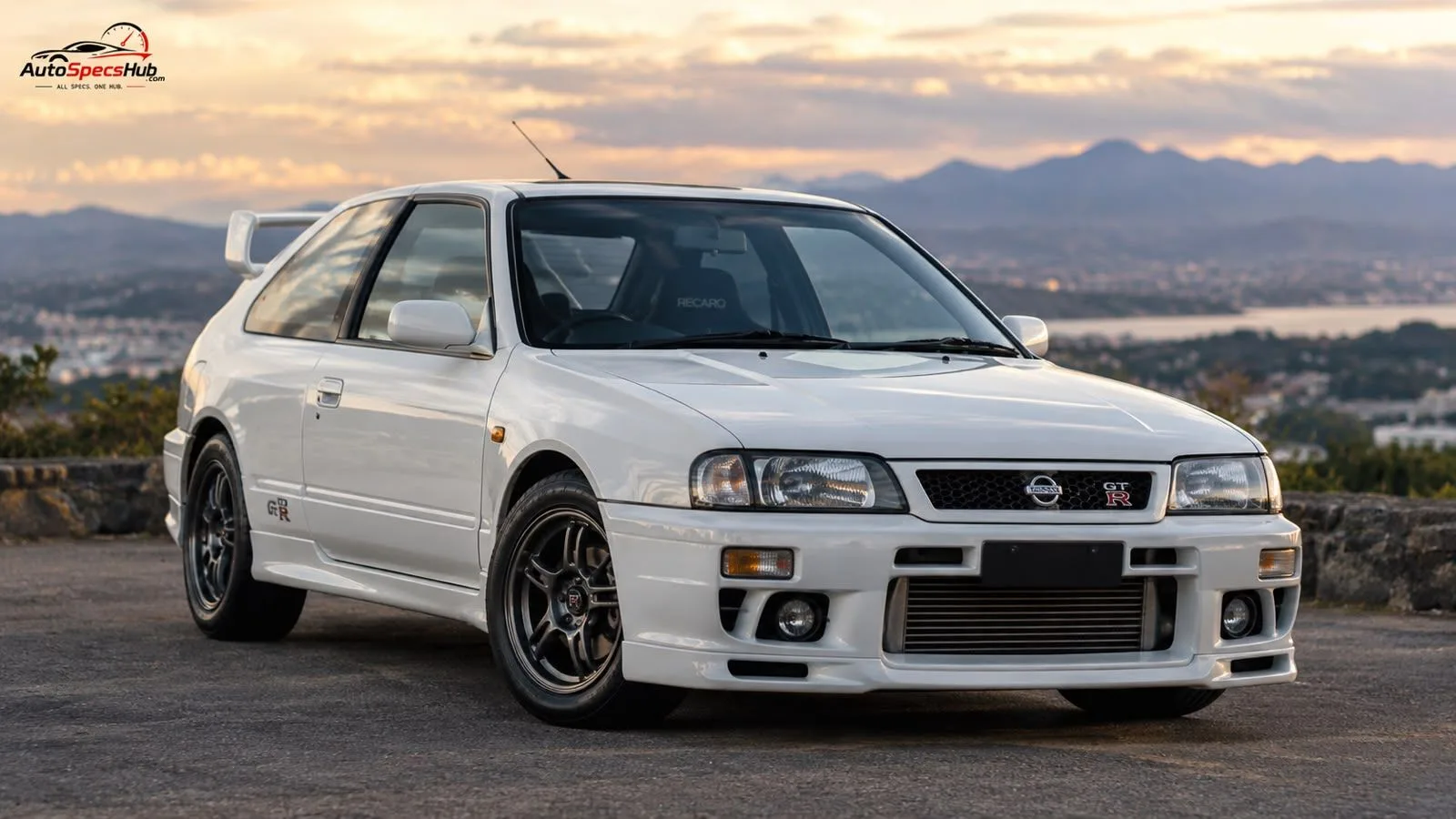
The Nissan Pulsar GTI-R is one of Nissan’s most interesting performance cars from the 1990s. Based on the compact Pulsar hatchback, it combined a turbocharged engine, four-wheel drive, and a relatively lightweight body in a package developed with rally competition in mind.
Unlike an ordinary hot hatch, the GTI-R was created to provide Nissan with a suitable production-based car for motorsport. That purpose influenced almost every major part of the vehicle, from its turbocharged SR20DET engine to its ATTESA four-wheel-drive system and distinctive bonnet bulge.
Today, the Pulsar GTI-R appeals to enthusiasts looking for something different from more familiar Japanese performance cars of the same era. Its rarity, compact dimensions, turbocharged power, and motorsport history give it plenty of character. However, buying one requires careful research because most examples are now decades old, and some have been heavily modified.
Here is what you should know about the Nissan Pulsar GTI-R, including its specifications, performance, rally history, reliability, and the main things to inspect before buying one.
What Is the Nissan Pulsar GTI-R?
The Nissan Pulsar GTI-R was introduced in 1990 as the high-performance version of the fourth-generation Pulsar N14. Nissan developed it to meet the requirements associated with its motorsport program, particularly Group A rallying.
The road-going GTI-R used a 2.0-liter SR20DET turbocharged four-cylinder engine paired with Nissan’s ATTESA four-wheel-drive system. Nissan’s Heritage Collection lists the road car with 230 PS and 284 Nm of torque.
Its compact body helped keep the car relatively light for its performance level. The 1990 RNN14 measured 3,975 mm long, 1,690 mm wide, and 1,400 mm high, with a 2,430 mm wheelbase and a curb weight of approximately 1,220 kg.
The large bonnet bulge is one of the GTI-R’s most recognizable features. It was functional rather than simply cosmetic, providing space for the intercooler positioned above the engine.
This combination made the Pulsar GTI-R very different from a standard family hatchback. It looked relatively small and simple, but underneath it had the hardware needed to deliver serious performance.
Nissan Pulsar GTI-R Specs
The SR20DET is the centerpiece of the GTI-R. The 1,998 cc inline-four uses double overhead camshafts and turbocharging, giving the compact hatchback considerably more power than the regular Pulsar models.
Nissan’s Heritage Collection lists the main road-car specifications as:
Engine: 1,998 cc inline-four
Engine family: SR20DET
Turbocharged: Yes
Maximum power: 169 kW / 230 PS at 6,400 rpm
Maximum torque: 284 Nm at 4,800 rpm
Drivetrain: ATTESA four-wheel drive
Suspension: Independent front strut and rear parallel-link strut
Front brakes: Ventilated discs
Rear brakes: Disc brakes
Tires: 195/55R14 82V
Wheelbase: 2,430 mm
Length: 3,975 mm
Width: 1,690 mm
Height: 1,400 mm
Curb weight: Approximately 1,220 kg
These figures describe the factory road-going specification. Individual cars can differ considerably today because many GTI-Rs have been modified, restored, or rebuilt during their lives.
If you're researching a particular example, it is better to verify its exact engine, drivetrain, dimensions, and other specifications instead of assuming every GTI-R is identical. You can check detailed car specifications to compare the information available for the vehicle you're considering.
Nissan Pulsar GTI-R Performance
The GTI-R’s performance comes from more than just its engine output. Its relatively low weight and four-wheel-drive system were equally important to the overall package.
With 230 PS from the factory, the car had serious performance for a compact hatchback of its era. The SR20DET produced 284 Nm of torque, giving the GTI-R strong acceleration once the turbocharged engine was operating in its effective power range.
The ATTESA four-wheel-drive system helped transfer that power to the road. Instead of relying entirely on the front tires, the GTI-R could use all four wheels to improve traction under acceleration.
That advantage was particularly useful on loose or slippery surfaces, which also made sense given the car’s rally-focused development.
The small dimensions further contributed to its character. At less than four meters long, the Pulsar GTI-R is much smaller than many modern performance cars. This gives it a compact feel and helps explain why the car remains attractive to enthusiasts who enjoy older, lightweight performance vehicles.
It is important, however, to judge the GTI-R in the context of its era. Modern performance cars can offer greater acceleration, power, technology, and refinement. The appeal of the Nissan is its overall combination of size, turbocharged performance, four-wheel drive, and old-school mechanical character.
Nissan Pulsar GTI-R and Rally History
The GTI-R’s rally background is central to its identity.
Nissan developed the car as the high-performance version of the N14 Pulsar to support its World Rally Championship ambitions. The production model provided the foundation for the competition car.
Nissan entered the GTI-R in WRC competition beginning in 1991. The rally version used a further developed SR20DET engine and ATTESA electronically controlled full-time four-wheel drive.
The competition specification was considerably more specialized than the road car. Nissan’s Heritage Collection lists the rally engine at approximately 300 PS, with more than 373 Nm of torque. The competition car also used larger 16-inch tires compared with the road-going model.
The GTI-R achieved its best WRC result with a third-place finish at the 1992 Swedish Rally. Nissan withdrew from WRC competition later that year, but the GTI-R also achieved success in Group N competition, securing a championship title in 1992.
This history gives the road car genuine motorsport significance. Its performance equipment was not developed solely as a marketing exercise. Nissan needed a production-based performance model that could form the basis of its competition program.
What Makes the Nissan Pulsar GTI-R Special?
The GTI-R stands out because of the way its different characteristics work together.
The car has the basic shape and proportions of a small family hatchback, but Nissan fitted it with a powerful turbocharged engine and four-wheel drive. That unusual combination gives it an identity that is difficult to confuse with an ordinary Pulsar.
Its styling is also distinctive. The large bonnet bulge immediately separates it from standard versions, while the compact body and relatively simple 1990s design give it a character that many modern performance cars lack.
Rarity adds another layer to its appeal. The GTI-R was never as common internationally as better-known Japanese performance models such as the Skyline GT-R or Toyota Supra. As a result, enthusiasts often have to spend more time researching individual cars and their histories.
Its motorsport connection is perhaps the most important difference. The GTI-R represents an era when manufacturers developed highly specialized road cars to support competition programs, something that is far less common in today's automotive market.
What Should You Check Before Buying a Nissan Pulsar GTI-R?
Buying a decades-old performance car requires looking beyond appearance and mileage. A GTI-R may have experienced hard driving, track use, engine modifications, or several owners during its lifetime.
Check the SR20DET Engine
The engine should be one of the first areas to inspect.
Look for oil leaks, unusual mechanical noises, overheating, smoke, or inconsistent running. A compression test can provide useful information about the condition of the engine if there are concerns about internal wear.
Service history is particularly valuable. An attractive engine bay does not necessarily indicate that the engine has been properly maintained.
Ask about previous engine work as well. If the engine has been rebuilt, upgraded, or retuned, documentation can help establish what was changed and how the work was performed.
Inspect the Turbocharger
The turbocharger is another important inspection point.
Watch for excessive smoke, unusual turbo noises, oil-related problems, or poor boost response. If the car has been modified, determine exactly what turbocharger, intercooler, exhaust system, and engine-management equipment have been fitted.
Modifications are common among surviving GTI-Rs and are not automatically a negative. However, poorly documented or badly installed upgrades can make future maintenance more difficult.
Check the Four-Wheel-Drive System
The ATTESA system is one of the defining mechanical features of the GTI-R, so drivetrain condition deserves close attention.
During a test drive, listen for unusual noises and watch for vibration, fluid leaks, or abnormal behavior. The transmission, differentials, driveshafts, and other related components should all be inspected.
Because the GTI-R is an older and relatively uncommon vehicle, finding specialist knowledge or replacement components may be more difficult than with a modern mainstream Nissan.
Look for Rust
Rust can be a major concern on a car that is now several decades old.
Inspect the wheel arches, sills, floor areas, suspension mounting points, and other structural sections. Pay particular attention to the underside of the vehicle, where corrosion can be difficult to spot during a quick inspection.
Fresh paint should not automatically be considered proof of a rust-free car. Previous repairs or corrosion may sometimes be hidden beneath newer bodywork.
Check Previous Modifications
Many GTI-Rs have been modified during their lives.
Common upgrades include turbochargers, intercoolers, exhaust systems, suspension components, brakes, wheels, and engine-management systems.
Ask whether the original parts are still available and whether the modifications were professionally installed. A well-documented modified car can be a good purchase, while an extensively modified example with no records can create unnecessary uncertainty.
Inspect the Interior and Electrical Equipment
The interior can reveal how the car has been treated.
Check the seats, dashboard, gauges, switches, windows, lights, heating system, and other electrical equipment. Look for damaged trim, water damage, aftermarket wiring, or electrical components that have been installed poorly.
A used car checklist can help you work through important inspection areas systematically rather than relying only on a quick visual impression.
Is the Nissan Pulsar GTI-R Reliable?
The GTI-R can be reliable when properly maintained, but its age must be considered.
Even a low-mileage example may have aging hoses, seals, suspension components, electrical parts, cooling-system components, or other items that require replacement. Time can affect an older car just as much as mileage.
Previous ownership is also important. Some examples have been driven hard or modified extensively, while others have been carefully maintained or restored.
The SR20DET has a strong reputation among Nissan enthusiasts, but the condition of an individual engine is more important than the reputation of the engine family. Proper maintenance, suitable fluids, sensible tuning, and quality modifications all contribute to long-term reliability.
For that reason, it is usually better to buy the best-maintained GTI-R you can find rather than choosing a cheaper example simply because it has a desirable specification.
Is the Nissan Pulsar GTI-R Worth Buying?
For the right enthusiast, the GTI-R can be an excellent choice.
It offers a combination that is difficult to find today: a compact 1990s hatchback, a turbocharged two-liter engine, four-wheel drive, strong factory performance, and genuine rally heritage.
It is not, however, the obvious choice for someone looking for inexpensive everyday transportation. Age-related repairs, specialist maintenance, parts availability, and previous modifications can all make ownership more demanding.
The car makes the most sense for someone who appreciates its history and mechanical character and is prepared to spend time finding a good example and maintaining it properly.
What Is the Biggest Advantage of the GTI-R?
The biggest advantage is the balance between compact size and serious performance hardware.
The GTI-R is small and relatively lightweight, yet it has a turbocharged engine and four-wheel drive. Its rally background gives those features additional significance.
Its rarity is another advantage for enthusiasts and collectors. Rather than owning another commonly seen Japanese performance car, a GTI-R offers something much less predictable and considerably more unusual.
Frequently Asked Questions
Is the Nissan Pulsar GTI-R rare?
Yes. The GTI-R was a specialized performance version of the Pulsar rather than a mainstream model. Compared with Nissan's more widely known performance cars, surviving examples are relatively uncommon, which contributes to its collector and enthusiast appeal.
What engine does the Nissan Pulsar GTI-R use?
The road-going GTI-R uses a 1,998 cc SR20DET turbocharged four-cylinder engine. Nissan listed the 1990 RNN14 with 230 PS and 284 Nm of torque.
Is the Nissan Pulsar GTI-R four-wheel drive?
Yes. The GTI-R uses Nissan's ATTESA four-wheel-drive system. Four-wheel drive was an important part of both the road car's performance and the vehicle's original rally-development purpose.
Was the Nissan Pulsar GTI-R built for rallying?
Yes. Nissan developed the GTI-R as the high-performance version of the N14 Pulsar to support its motorsport ambitions. The competition version went on to compete in WRC and Group N events during the early 1990s.
What should I look for when buying a GTI-R?
Focus on the SR20DET engine, turbocharger, four-wheel-drive system, rust, service history, modifications, and electrical equipment. Because of the car's age and rarity, a professional inspection before purchase is highly recommended.
Final Thoughts
The Nissan Pulsar GTI-R remains one of the most distinctive Japanese performance cars of the 1990s. Its appeal goes beyond the figures on a specification sheet. The combination of a turbocharged SR20DET engine, ATTESA four-wheel drive, compact dimensions, and genuine rally development gives it a character that is difficult to reproduce.
At the same time, buying one today requires patience and careful research. Age, corrosion, drivetrain wear, modifications, and parts availability can turn an apparently inexpensive GTI-R into a costly project.
The best approach is to focus on condition, maintenance, and documentation rather than simply chasing the highest power figure or lowest asking price. A well-maintained example with sensible modifications and a clear history can provide a memorable ownership experience while preserving an important part of Nissan's performance-car history.