
CVT vs Automatic Transmission: Fuel Economy, Driving Feel, and Maintenance
CVT vs automatic transmission explained: compare fuel economy, driving feel, maintenance, performance, reliability, and everyday practicality to find the right option for your car.
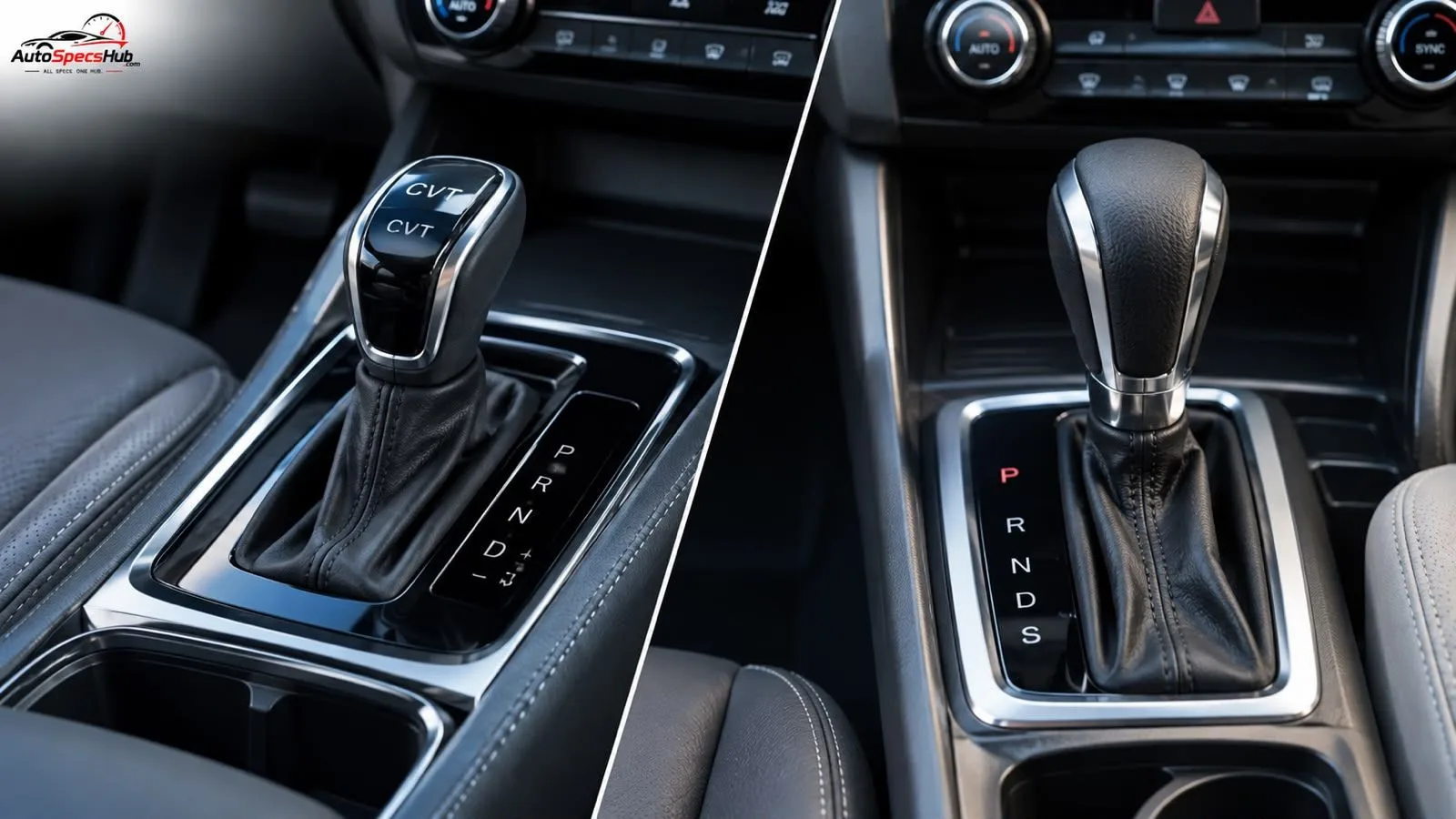
Choosing between a CVT and a conventional automatic transmission can affect more than how a car changes gears. The transmission influences acceleration, fuel economy, engine behavior, comfort, maintenance requirements, and even the way a vehicle feels during everyday driving. Although both systems allow the driver to select Drive without manually changing gears, they use very different methods to deliver power to the wheels.
A CVT, or continuously variable transmission, changes its ratio continuously instead of using a fixed set of gears. A conventional automatic uses individual gear ratios and shifts between them as speed and engine load change. These differences can be subtle during relaxed driving but become more noticeable during acceleration, climbing hills, or passing.
For anyone comparing vehicles, understanding these differences can make it easier to choose a transmission that fits their driving habits. This guide explains CVT vs automatic transmission with a focus on fuel economy, driving feel, maintenance, reliability, and everyday practicality.
CVT vs Automatic Transmission: What's the Difference?
The main difference is how each transmission manages the relationship between engine speed and vehicle speed.
A conventional automatic has a defined number of forward gears. During acceleration, it moves from one gear to another according to factors such as throttle input, road speed, engine load, and driving mode. Each gear provides a specific ratio.
A CVT does not have the same fixed gear sequence. Instead, it continuously adjusts its ratio to keep the engine operating at an appropriate speed for the conditions. This allows the engine and transmission to work together without traditional upshifts and downshifts.
What Is a CVT?
A continuously variable transmission is designed to provide an uninterrupted range of transmission ratios. Many conventional CVTs use a pair of variable-diameter pulleys connected by a belt or chain. By changing the effective diameter of the pulleys, the transmission can alter the ratio between the engine and driven wheels.
The benefit is flexibility. Instead of selecting the next available gear, the CVT can choose a ratio that suits the current demand. During gentle acceleration, it can prioritize efficiency. When more power is requested, it can adjust the ratio to keep the engine in a useful operating range.
This design is common in compact cars, hybrids, and vehicles where efficiency and smooth commuting are important priorities.
What Is a Conventional Automatic Transmission?
A conventional automatic transmission uses fixed gear ratios and automatically selects between them. Modern examples may have six, eight, nine, ten, or more forward gears, depending on the vehicle.
The transmission uses electronic controls and other components to determine when a shift should occur. A torque converter is commonly used to connect the engine to the transmission and allow the vehicle to move away smoothly from a stop.
Because the transmission changes between defined ratios, drivers can usually feel or hear the engine move through the gears. Some modern automatic transmissions make these transitions extremely smooth, while performance-oriented systems can provide particularly responsive shifts.
CVT vs Automatic: Fuel Economy
Fuel economy is one of the strongest reasons manufacturers choose CVTs.
Because a CVT can select an appropriate ratio without being restricted to fixed gears, it can keep the engine closer to an efficient operating range. This can be especially useful during stop-and-go driving, gradual acceleration, and steady cruising.
However, a conventional automatic is not automatically inefficient. Modern automatic transmissions use additional gears, sophisticated shift programming, lock-up systems, and advanced control software to reduce unnecessary engine speed. In some vehicles, the difference in real-world fuel consumption may be relatively small.
Actual fuel economy depends on much more than the transmission. Engine design, vehicle weight, aerodynamics, tires, drivetrain configuration, traffic, weather, road conditions, and driving style all have an effect.
For this reason, buyers should compare the official fuel-economy figures of the exact vehicles they are considering rather than assuming one transmission will always consume less fuel.
CVT vs Automatic: Driving Feel
The driving experience is where the two systems are easiest to distinguish.
A conventional automatic generally produces a sequence of gear changes. As the vehicle accelerates, engine speed rises, the transmission shifts, and the engine settles into the next ratio. This creates a familiar rhythm that many drivers associate with automatic cars.
A CVT can accelerate without those traditional shifts. When the accelerator is pressed, the transmission can adjust its ratio while the engine settles at a suitable RPM. Under light throttle, this can feel very smooth. Under hard acceleration, however, the engine may hold a higher RPM while the vehicle continues gaining speed.
Some drivers appreciate the uninterrupted response, while others prefer the changing engine note and shift points of a conventional automatic. Manufacturers sometimes program simulated ratios into a CVT to make acceleration feel more familiar.
Neither experience is universally better. The choice largely comes down to whether you prefer seamless operation or the more traditional sensation of shifting through gears.
Which Is Better for City Driving?
City driving often involves repeated stops, starts, and changes in speed. A CVT can work well in this environment because it can continuously adjust its ratio instead of moving through a fixed sequence of gears.
The result can be smooth progress through traffic and efficient operation during moderate acceleration. Drivers who spend much of their week commuting in busy urban areas may therefore find a CVT appealing.
A conventional automatic can also be excellent in the city. Modern units are designed to handle frequent shifting without making every change obvious, and their low-speed behavior can be very refined.
The better option depends on the individual vehicle and what the driver values most. For a relaxed commuter, smoothness and efficiency may favor a CVT. For someone who prefers a more responsive, familiar feel, an automatic may be preferable.
Which Is Better for Highway Driving?
Both transmission types can perform well on highways.
During steady cruising, a CVT can select a ratio that keeps engine speed appropriate for the load and road speed. A conventional automatic can use a high gear to achieve a similar result, particularly when it has a large number of forward ratios.
Highway comfort also depends on factors such as engine noise, cabin insulation, suspension tuning, and vehicle design. Therefore, a highway driver should evaluate the whole vehicle rather than choosing based on transmission type alone.
CVT vs Automatic: Maintenance
Both transmission types need the correct maintenance, but their service requirements can differ.
A CVT requires transmission fluid designed specifically for its operating system. The correct fluid is important because the transmission depends on particular lubrication and friction characteristics. Service procedures and recommended intervals vary by manufacturer and model.
A conventional automatic also uses specialized transmission fluid and may have its own inspection or replacement schedule. Some vehicles have longer service intervals, while others call for regular fluid maintenance depending on use.
Regular servicing is one of the simplest ways to support long-term transmission operation. Checking for leaks and responding to warning lights or unusual behavior early can also prevent a minor issue from becoming a larger repair.
Which Is More Reliable?
There is no universal answer to whether a CVT or conventional automatic is more reliable.
Reliability depends on the exact transmission design, vehicle application, manufacturing quality, maintenance history, driving conditions, and how the vehicle has been used. Some CVTs have strong reliability records, while certain conventional automatics have also experienced well-known problems.
When evaluating a used vehicle, the transmission's reputation for that specific model year is more useful than a broad statement about CVTs or automatics.
Warning signs deserve attention regardless of transmission type. Delayed engagement, slipping, shuddering, harsh operation, unusual noises, fluid leaks, overheating, or warning lights can indicate a problem that should be professionally inspected. For more detail, see the transmission problems guide.
CVT vs Automatic: Pros and Cons
CVT Advantages
Smooth acceleration without conventional gear changes
Strong fuel-efficiency potential
Ability to keep engine speed within an efficient range
Well suited to many commuting applications
Comfortable operation in frequent stop-and-go traffic
CVT Disadvantages
Some drivers dislike the high-RPM feel during hard acceleration
Requires the correct CVT-specific fluid and service procedures
Driving response can feel different from a traditional automatic
Major repairs can be costly depending on the vehicle
Conventional Automatic Advantages
Familiar shifting behavior
Strong performance potential
Wide availability across cars, SUVs, trucks, and performance vehicles
Can provide excellent fuel economy with modern multi-speed designs
Often well suited to applications requiring strong acceleration or towing, depending on the vehicle
Conventional Automatic Disadvantages
Gear changes may be noticeable in some vehicles
More mechanical components can mean complex repairs
Efficiency varies considerably between transmission designs
Which Transmission Should You Choose?
A CVT can make sense if your priorities are smooth commuting, efficiency, and easy operation. It is particularly worth considering if most of your driving takes place in urban areas and you prefer an uninterrupted acceleration feel.
A conventional automatic may be a better match if you enjoy traditional gear changes, want a more familiar response, or are considering a vehicle designed around towing or performance.
When comparing different transmission types, it also helps to understand how a conventional automatic compares with a manual gearbox in terms of daily comfort, fuel economy, and driving involvement. Our guide to Manual vs Automatic explores those differences in more detail.
What to Check Before Buying a Used CVT or Automatic
A used car deserves a closer inspection regardless of its transmission type.
For a CVT, review the service history and confirm that the correct fluid and recommended maintenance were used. During a test drive, pay attention to hesitation, shuddering, unusual noises, inconsistent acceleration, or warning lights.
For a conventional automatic, look for harsh or delayed shifts, slipping, unusual sounds, vibration, or difficulty engaging Drive or Reverse.
A professional inspection can provide additional confidence before purchase, particularly when buying an older or higher-mileage vehicle.
Frequently Asked Questions
Is a CVT better than an automatic?
Neither is automatically better. A CVT may be preferable for efficiency and smooth commuting, while a conventional automatic may suit drivers who prefer traditional shifts and stronger performance feel.
Which transmission gets better fuel economy?
A CVT often has an efficiency advantage because it can continuously adjust its ratio, but the actual result depends on the vehicle, engine, driving conditions, and calibration.
Does a CVT feel different from an automatic?
Yes. A conventional automatic changes between fixed gears, while a CVT can change ratios continuously. This can make a CVT feel smoother but different during hard acceleration.
Which transmission requires more maintenance?
Neither category has a universal maintenance schedule. Service requirements depend on the specific manufacturer, transmission, model, and driving conditions.
Are CVTs reliable?
A properly maintained CVT can be reliable, but reliability varies by design and model year. Researching the exact vehicle is more useful than judging every CVT together.
Is an automatic better for towing?
Many vehicles designed for towing use conventional automatic transmissions, but towing capability is determined by the complete vehicle and manufacturer rating. Always check the exact vehicle's official towing capacity.
Final Verdict
CVT and conventional automatic transmissions take different approaches to the same job: delivering engine power to the wheels efficiently and smoothly.
A CVT is especially attractive for drivers who value smooth operation and fuel-efficiency potential. A conventional automatic remains a strong choice for drivers who prefer traditional shifts, responsive gear changes, or a vehicle designed for more demanding applications.
The smartest choice is not simply to pick one transmission type. Compare the exact vehicle's fuel economy, performance, maintenance schedule, reliability record, intended use, and ownership costs.
For daily commuting, a well-designed CVT can be an excellent solution. For drivers who want a familiar driving experience or greater performance-oriented flexibility, a conventional automatic may be the better fit. In either case, proper maintenance and choosing the right vehicle for your needs matter more than the transmission label alone.