
How Long Can You Drive on a Spare Tire? What to Know Before You Keep Driving
How long can you drive on a spare tire? Learn the real mileage and speed limits, why donut spares are different, and what to do before driving farther.
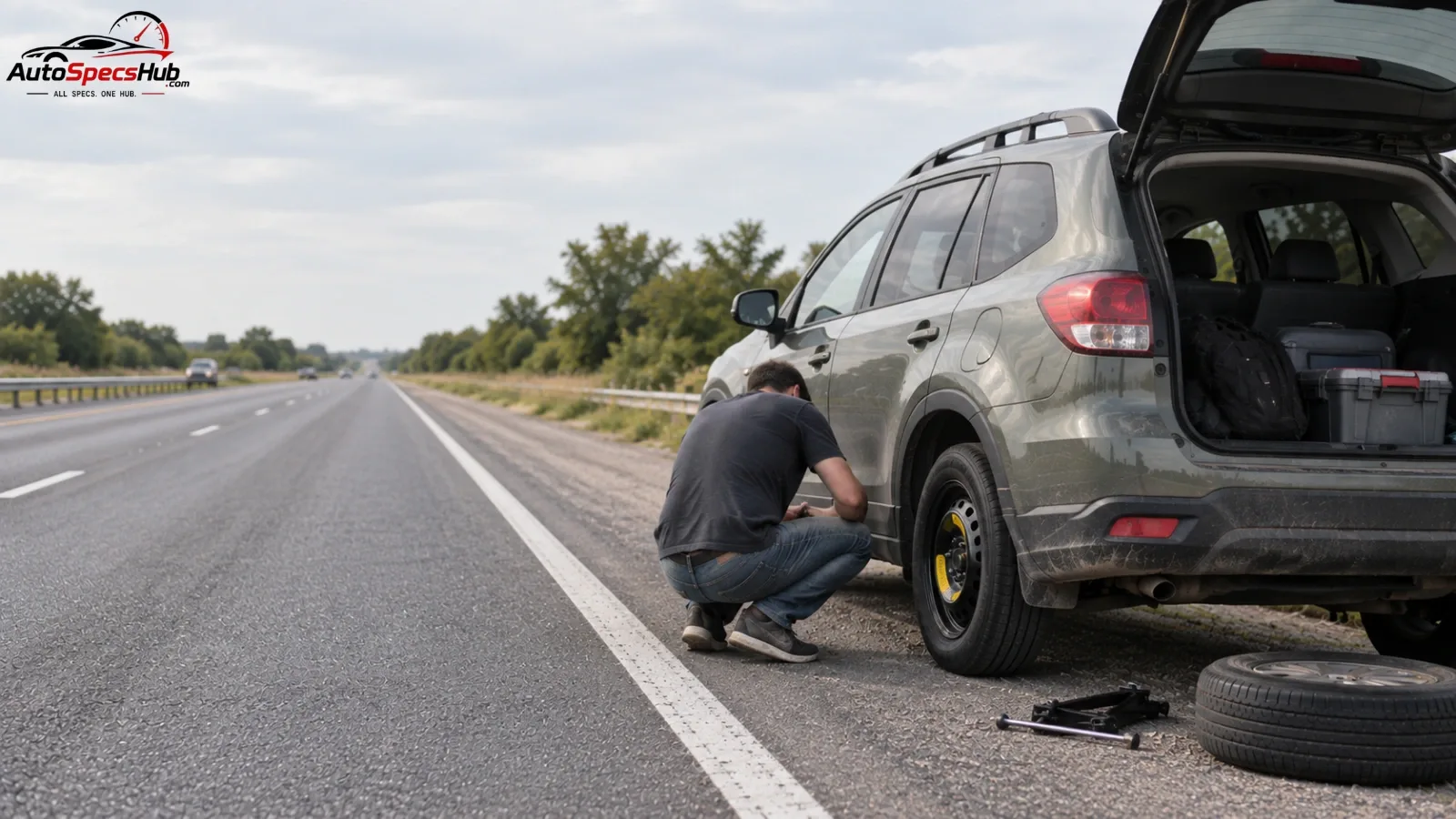
A spare tire can get you out of a bad situation, but it isn't meant to turn a flat tire into a normal driving day. If you've installed a compact spare, about 50 miles and 50 mph are common limits, but those numbers aren't universal. The instructions on your spare and in your owner's manual take priority.
That distinction matters because spare tires come in different types. A small temporary “donut” is built for short-distance emergency use, while a matching full-size spare may have very different limitations.
So if you're driving on a spare right now, the goal isn't to see how long you can make it last. The goal is to get the vehicle somewhere safe where the original tire can be repaired or replaced.
The 50-Mile Rule Is Only a Starting Point
The familiar 50-mile rule exists for a reason. Compact temporary spares are designed to provide short-term mobility rather than the same capability as the vehicle's regular tires.
Many temporary spares carry a maximum speed of 50 mph and are intended for roughly 50 miles of use. But you shouldn't treat those figures as a universal allowance.
Your particular spare may have a different speed or distance recommendation. The sidewall can provide important information, while the owner's manual may give additional instructions for your vehicle.
Think of 50 miles as a common upper guideline, not a target.
If the tire shop is five miles away, there's no reason to keep driving for another 45 miles simply because you technically could. The sooner you restore the normal tire, the better.
Why a Donut Spare Isn't Like Your Normal Tire
The difference between a compact spare and a regular tire goes beyond appearance.
A temporary spare is typically narrower and lighter, with a different tread design and construction. It may also have a different diameter from the tire it replaced.
Those differences can affect how the vehicle responds to:
Braking
Cornering
Acceleration
Steering
Wet pavement
Emergency maneuvers
You may notice that the vehicle feels different as soon as you leave the parking lot. That's normal to a point, but it's also a reminder that the spare isn't intended for ordinary driving.
This is why driving conservatively matters. Avoid sudden acceleration, hard braking and aggressive cornering. Give yourself more room to stop and take extra care around potholes, standing water and rough pavement.
A spare is there to restore basic mobility, not to restore the vehicle's normal handling.
Highway Driving Deserves Extra Caution
A temporary spare becomes more limiting when you're dealing with high-speed traffic.
If you get a flat on the highway, deal with the immediate safety problem first. Once the spare is installed, don't assume you should continue hundreds of miles toward your original destination.
If possible, leave the highway and take a route where you can stay within the spare's speed limitation and reach a tire shop quickly.
If you have no reasonable alternative and need to travel a short distance on a highway, stay within the spare's stated limit and drive cautiously. Avoid unnecessary lane changes and leave plenty of space around the vehicle.
The important question isn't “Can the spare technically go farther?”
It's “Why am I still driving on it when I could have the normal tire repaired?”
That mindset is much safer.
Can You Drive on a Spare for a Few Days?
Sometimes circumstances make an overnight delay unavoidable.
For example, you might get a flat late in the evening when local tire shops are closed. Leaving a properly installed spare on the vehicle until the next morning isn't automatically a problem.
What you shouldn't do is turn that temporary situation into several days of normal driving.
A few short trips can quickly add unnecessary mileage. If you're commuting, shopping and running errands while waiting for a tire appointment, you're using the spare for exactly the type of driving it wasn't designed to handle.
If the repair can be completed the next morning, leave the vehicle parked whenever possible and deal with the original tire as soon as the shop opens.
Full-Size Spares Change the Equation
The word “spare” doesn't always mean “donut.”
Some vehicles carry a full-size spare that is the same size as the regular tires. If it matches the vehicle's required tire and wheel specifications, it can be much closer to a normal replacement than a compact temporary spare.
But there's an important catch.
A full-size spare isn't necessarily an exact match just because it looks the same size. It could have a different tire model, tread depth, construction or other specification.
That matters because tires on the same vehicle are expected to work together.
So don't assume:
full-size spare = unlimited driving
Instead, check the owner's manual and make sure the spare meets the vehicle's requirements.
If it's an exact matching tire and the manufacturer permits normal use, its limitations can be very different from those of a temporary donut.
AWD and 4WD Vehicles Need More Attention
A spare tire can present an additional concern on some AWD and 4WD vehicles.
The issue isn't that every AWD vehicle automatically has a shorter spare-tire limit. Rather, some drivetrains are sensitive to differences in tire diameter or rolling circumference.
A temporary spare may have a different overall diameter from the other three tires. Depending on the vehicle, that difference can affect the drivetrain.
That's why you shouldn't rely solely on a generic 50-mile rule if your vehicle has AWD or 4WD. The manufacturer's instructions should take priority.
If the manual gives specific instructions about using the spare, follow them even if the tire itself appears to be in perfect condition.
Understanding how FWD and AWD differ can also help explain why tire differences matter more on some vehicles than others.
Check the Spare Before You Start Driving
A spare that's been sitting under the cargo floor for years isn't automatically ready for use.
Before relying on it, check the basics.
Check the inflation pressure
Use the pressure specified for the spare rather than assuming it should match the other four tires.
Temporary spares often require substantially higher inflation pressure than regular passenger tires. The correct figure may be printed on the spare itself or listed in the owner's manual.
Check the speed limitation
Look for the maximum speed marking on the temporary spare. If it specifies a lower speed than the commonly quoted 50 mph, the tire's stated limit wins.
Check its condition
Look for obvious cracks, damage or other signs of deterioration.
An unused spare can age even though it has almost no mileage. If it has been stored for many years, its condition deserves attention before you depend on it.
Make sure the wheel is properly secured
After installation, the wheel should be properly tightened according to the vehicle manufacturer's specifications.
If you're not confident that you've installed it correctly, don't start driving simply because the tire looks inflated.
What Should You Do With the Flat Tire?
Don't automatically assume the damaged tire needs to be thrown away.
A puncture in the tread may be repairable if the damage meets the tire manufacturer's requirements and the tire hasn't been driven while severely underinflated or otherwise damaged.
A professional tire inspection is the right way to determine that.
Damage to the sidewall is a different matter and generally isn't something that should be repaired.
If the original tire can be safely repaired, you can return the vehicle to its normal tire configuration without buying an unnecessary replacement.
And if you're inspecting a used vehicle, don't forget the emergency equipment. The spare, jack and related tools can tell you something about how well the vehicle has been maintained. They're worth checking alongside the items on a thorough used car inspection checklist.
What If the Tire Shop Is More Than 50 Miles Away?
This is where people can get into trouble.
If your compact spare has a 50-mile recommendation and the nearest suitable tire shop is 70 or 100 miles away, don't treat the limit as something you can simply stretch because you have no convenient alternative.
Consider:
Roadside assistance
A mobile tire service
A closer repair facility
Having the vehicle transported
Waiting somewhere safe until help is available
If you're stranded somewhere dangerous, getting yourself and your passengers away from immediate danger comes first.
But once you're in a safe location, the sensible solution is to arrange assistance rather than deliberately exceeding the spare's limitations.
The spare has already done its job by getting the vehicle mobile. You don't need to make it your long-term solution.
Frequently Asked Questions
How long can you drive on a spare tire?
For a typical compact temporary spare, about 50 miles is a common guideline, but the exact limit depends on the tire and vehicle. Check the spare's sidewall and owner's manual.
How fast can you drive on a donut spare?
Many compact spares have a 50 mph maximum, but your specific spare may have a different limit. Follow the marking on the tire and the vehicle manufacturer's instructions.
Can you drive 100 miles on a spare tire?
You shouldn't plan to. A compact spare is designed for short-term emergency use, so driving significantly beyond its recommended distance defeats its intended purpose.
Can you drive on a spare overnight?
Yes, leaving a properly installed spare on the vehicle overnight is generally not the issue. The important thing is to avoid unnecessary driving and have the original tire repaired or replaced as soon as practical.
Can you drive on a spare tire in the rain?
You may encounter rain while using a spare, but drive more cautiously because the temporary tire may not provide the same wet-weather performance as your regular tire. Reduce speed and avoid sudden maneuvers.
Can a full-size spare be used permanently?
Not automatically. A full-size spare that exactly matches the vehicle's required tire specifications may be suitable for normal use, but an unmatched full-size spare should not automatically be treated as a permanent replacement.
Does an AWD vehicle need a special spare tire?
Some AWD vehicles have specific requirements for tire size, diameter and tread differences. Check the owner's manual before driving any significant distance on a temporary spare.
Get the Normal Tire Back as Soon as You Can
A spare tire is best thought of as a bridge between a flat and a proper repair, not a replacement for the tire you normally drive on.
For a typical compact spare, 50 miles and 50 mph are common upper guidelines, but your vehicle and tire may specify something different. Those instructions should always take priority.
If you've had to install the spare, drive only as far and as fast as necessary to reach a safe solution. Get the damaged tire repaired or replaced, check the spare before storing it again, and you'll be ready if another flat happens down the road.