
Subaru Crosstrek Towing Capacity: How Much Can It Tow?
Looking for the Subaru Crosstrek towing capacity? Learn how much the 2026 Crosstrek can tow, how the standard model compares with the Wilderness, and what to know about trailer weight, tongue weight, AWD, and towing equipment.
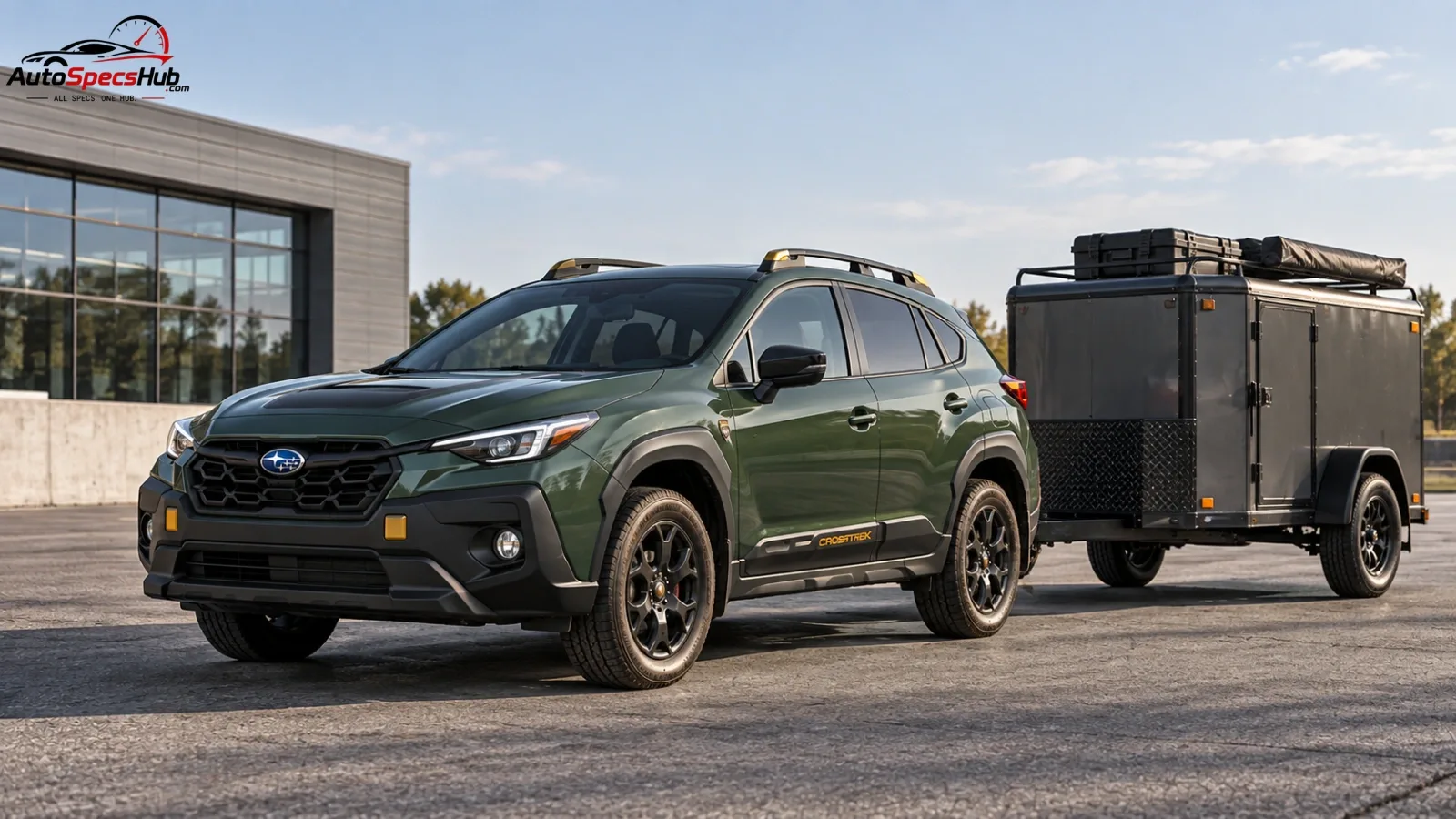
The Subaru Crosstrek towing capacity ranges from 1,500 to 3,500 pounds, depending on the version you choose. That 2,000-pound difference is substantial enough to change what kind of trailer you can realistically use, making the choice of Crosstrek trim especially important for buyers who plan to tow.
For 2026, regular Crosstrek models are rated to tow up to 1,500 pounds, while the Crosstrek Wilderness can tow up to 3,500 pounds. The Wilderness also brings a more capability-focused setup, including 9.3 inches of ground clearance, standard Symmetrical All-Wheel Drive, dual-function X-MODE, and revised gearing. Subaru lists a 180-horsepower 2.5-liter BOXER engine for the 2026 Wilderness.
That makes the headline number easy to understand, but the more useful question is whether that capacity matches the trailer you actually intend to tow.
2026 Subaru Crosstrek Towing Capacity at a Glance
The difference between the regular Crosstrek and Wilderness deserves a quick reference:
2026 Crosstrek version | Maximum towing capacity |
Non-Wilderness Crosstrek | 1,500 lbs |
Crosstrek Wilderness | 3,500 lbs |
Subaru's 2026 specifications identify the Crosstrek at 1,500 pounds and the Wilderness at 3,500 pounds.
So there isn't one towing figure that applies to every 2026 Crosstrek. If you are shopping for a standard model, 1,500 pounds is the number to work with. If you choose the Wilderness, the maximum rises to 3,500 pounds.
That distinction should be established before looking at trailer options, because a trailer that works comfortably with the Wilderness may be completely unsuitable for a regular Crosstrek.
What 1,500 Pounds Looks Like in Practice
A 1,500-pound rating gives the standard Crosstrek useful light-duty towing capability, but it isn't intended for large trailers.
Depending on their actual loaded weight, suitable applications can include:
Small utility trailers
Lightweight cargo trailers
Some compact camping trailers
Personal watercraft trailers
Lightweight motorcycle trailers
Small recreational equipment trailers
The important part is the phrase actual loaded weight.
A trailer's advertised dry weight is not necessarily what it weighs when you're ready to leave home. Camping gear, fuel, water, tools, luggage, batteries, and other equipment can add hundreds of pounds.
For example, a trailer that starts at 1,200 pounds empty may be considerably heavier once fully loaded. With a standard Crosstrek's 1,500-pound ceiling, that additional weight can quickly reduce the available margin.
For occasional light towing, however, 1,500 pounds can be enough. The key is choosing a trailer that leaves reasonable capacity rather than routinely operating right at the maximum.
Why the Wilderness Changes the Equation
The Crosstrek Wilderness is the version to look at when towing is a more important part of the buying decision.
Its 3,500-pound rating is more than double the standard Crosstrek's capacity. Subaru pairs that higher rating with a 2.5-liter, 180-hp BOXER engine, 9.3 inches of ground clearance, standard Symmetrical All-Wheel Drive, dual-function X-MODE, all-terrain tires, and revised drivetrain gearing.
Those features serve more than towing alone. The Wilderness is designed for buyers who want additional capability away from paved roads, so the higher tow rating fits naturally into the vehicle's overall purpose.
Still, 3,500 pounds is a maximum, not a target.
A trailer weighing 2,500 pounds gives you considerably more margin than one weighing 3,450 pounds. Acceleration, braking, hills, wind, road surface, passengers, and cargo can all make a heavily loaded combination more demanding.
The Wilderness therefore gives you much more flexibility, but it doesn't eliminate the need to match the trailer properly.
Trailer Weight Isn't the Whole Story
Towing capacity gets most of the attention, but the trailer's total weight isn't the only figure that matters.
Tongue weight is the downward force a trailer places on the vehicle's hitch. Too much can overload the rear of the vehicle, while too little can contribute to instability.
Subaru's 2026 accessory documentation rates its standard Crosstrek hitch at 1,500 pounds maximum towing capacity and 150 pounds of tongue weight. The Crosstrek Wilderness hitch is rated at 3,500 pounds and 350 pounds of tongue weight.
That makes proper trailer loading particularly important.
Heavy equipment shouldn't simply be placed wherever there is available space. The load needs to be distributed appropriately so the trailer remains stable and the hitch isn't subjected to excessive weight.
You also need to make sure the hitch itself is appropriate for the specific Crosstrek configuration. Installing a hitch does not automatically increase the vehicle's factory towing rating.
AWD Helps With Traction, Not Tow Rating
Every 2026 Crosstrek uses Subaru's Symmetrical All-Wheel Drive, and that can be useful when towing over wet roads, loose surfaces, snow, gravel, or uneven terrain. Subaru specifically highlights the system's traction and stability benefits across different road and trail conditions.
But AWD does not increase the vehicle's maximum towing capacity.
A regular Crosstrek remains rated at 1,500 pounds. The Wilderness reaches 3,500 pounds because Subaru engineered that configuration with the additional towing capability.
That distinction is worth remembering when comparing drivetrains. If you're also weighing the broader differences between FWD vs AWD, the drivetrain itself should be considered separately from the vehicle's official tow rating.
Towing Equipment and Trailer Brakes
The heavier the trailer becomes, the more important the supporting equipment is.
Subaru's 2026 accessory documentation states that trailer brakes may be required by state law for heavier loads and advises owners to consult the owner's manual.
Legal requirements vary by location, so you should check the rules that apply where you will actually tow.
Even when a particular lightweight trailer doesn't legally require independent brakes, stopping a vehicle with a trailer attached is different from stopping the vehicle alone.
Before setting off, check the:
Hitch and ball-mount compatibility
Trailer brakes and wiring
Safety chains
Trailer lights
Trailer tire condition and pressure
Vehicle tire condition and pressure
Trailer loading and weight distribution
Actual loaded trailer weight
Applicable local towing requirements
These details become especially important as the trailer approaches the vehicle's maximum rating.
The Wilderness Has More Capacity, But Bigger Isn't Always Better
A 3,500-pound towing rating makes the Wilderness significantly more capable than a standard Crosstrek, but that doesn't automatically make it the right purchase for every buyer.
If your trailer normally weighs 1,000 to 1,300 pounds, buying the Wilderness solely for its towing capacity may not make much sense. The regular Crosstrek already has enough capacity for that type of use.
The situation changes when your trailer is consistently above 1,500 pounds. At that point, the standard Crosstrek is no longer an appropriate choice, and the Wilderness becomes the relevant version to consider.
If you're also deciding whether the Crosstrek's compact dimensions are enough for passengers, cargo, and towing, the distinction between a compact SUV vs midsize SUV can help put that decision into perspective.
The goal isn't to buy the vehicle with the biggest possible tow rating. It's to have enough capacity for your normal needs without unnecessarily moving into a larger or more expensive vehicle.
When a Larger SUV Makes More Sense
The Crosstrek makes a lot of sense when you want a relatively compact vehicle that can handle everyday driving and occasional towing.
There is a point, however, where a larger SUV or pickup becomes the better tool.
If you regularly tow close to 3,500 pounds while also carrying several passengers and substantial cargo, the Crosstrek Wilderness may not provide the same overall margin and space as a larger vehicle.
The same applies if towing is a central part of your lifestyle rather than an occasional requirement. A vehicle designed around heavier towing can offer advantages in passenger space, cargo capacity, stability, and overall towing margin.
In other words, 3,500 pounds is where the Crosstrek Wilderness reaches its ceiling, not where larger tow vehicles begin to look unnecessary.
Choosing the Right Crosstrek for Towing
For occasional light-duty towing, the standard Crosstrek's 1,500-pound rating is likely to be sufficient.
If your loaded trailer exceeds 1,500 pounds, the choice becomes straightforward: the standard Crosstrek isn't the right configuration, while the Wilderness offers up to 3,500 pounds of towing capacity.
The Wilderness is also a logical choice for buyers who want its additional ground clearance and off-road hardware even when towing isn't their primary reason for buying it.
If you're comparing the Crosstrek with other vehicles, it's worth looking beyond towing capacity and considering the complete car specifications before making a decision.
Frequently Asked Questions
What is the Subaru Crosstrek towing capacity?
For 2026, the standard Subaru Crosstrek is rated to tow up to 1,500 pounds, while the Crosstrek Wilderness can tow up to 3,500 pounds.
Can a Subaru Crosstrek tow 3,500 pounds?
Yes, but the 3,500-pound rating applies to the Crosstrek Wilderness. Non-Wilderness Crosstrek configurations are rated at 1,500 pounds.
Can the Crosstrek tow a small camper?
Yes, provided the camper and trailer's actual loaded weight stays within the vehicle's towing rating and the complete setup meets all applicable weight and equipment requirements.
Is the Crosstrek Wilderness better for towing?
Yes. Its 3,500-pound maximum is 2,000 pounds higher than the standard Crosstrek's rating, and Subaru pairs it with additional capability-focused equipment.
Does AWD increase the Subaru Crosstrek's towing capacity?
No. AWD can help with traction, but it doesn't change the vehicle's official tow rating. The standard Crosstrek remains at 1,500 pounds, while the Wilderness is rated at 3,500 pounds.
How much tongue weight can the Crosstrek handle?
Subaru's 2026 accessory documentation lists 150 pounds of tongue weight for the standard Crosstrek hitch and 350 pounds for the Wilderness hitch.
Where the Crosstrek Fits as a Tow Vehicle
The Subaru Crosstrek towing capacity gives the model a useful range of capability, but the right version depends on the trailer you actually intend to pull.
The standard Crosstrek's 1,500-pound rating makes it suitable for lighter trailers and occasional towing. The Crosstrek Wilderness's 3,500-pound rating is a major step up and makes it the clear choice when a standard Crosstrek doesn't have enough capacity.
The smartest approach is to start with the trailer's loaded weight, then consider tongue weight, braking, passengers, cargo, road conditions, and how often you'll tow. If your normal trailer is comfortably below 1,500 pounds, there's little reason to choose the Wilderness purely for its towing rating.
If your trailer is above 1,500 pounds but within 3,500 pounds, the Wilderness is the Crosstrek that makes sense. If you regularly need more than 3,500 pounds, that's the point where a larger SUV or pickup becomes the more appropriate choice.