
Tesla Battery Replacement Cost Depends on More Than the Battery
Tesla battery replacement cost can vary widely by model, battery condition, repair method, warranty coverage, and labor. Learn what replacement may cost and when a full battery pack is actually necessary.
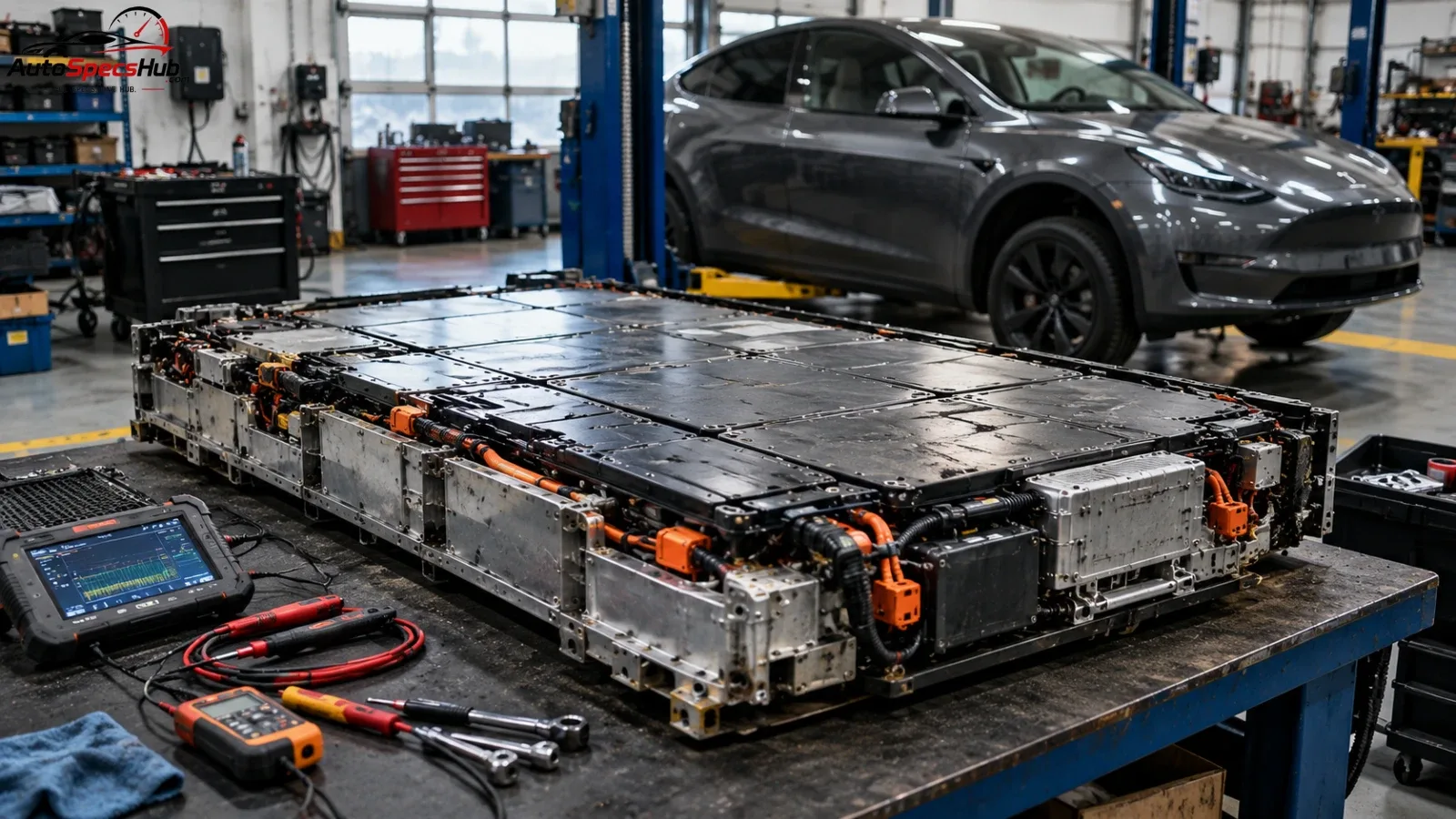
A Tesla can go years without the kind of engine repairs that come with a gasoline car, but there is one component that can make an older EV owner stop and think: the high voltage battery. If that battery develops a serious fault outside its warranty, the repair bill can be substantial, which is why Tesla battery replacement cost is such an important concern for owners and used car buyers.
The problem is that a battery showing reduced range does not automatically need to be replaced. A Tesla may have normal battery degradation, a fault affecting part of the pack, or a problem serious enough to require a complete replacement. Warranty coverage, battery configuration, repair method, labor, and the vehicle's age can all change the final price. Before assuming you need a new battery, it helps to understand what you are actually paying for.
How Much Does a Tesla Battery Replacement Cost?
There is no single official Tesla replacement price that applies to every model. Current independent estimates put some complete out-of-warranty replacements in the $10,000 to $22,000+ range, while model-specific estimates can extend higher depending on the vehicle and repair route. One current 2026 estimate places Model 3 replacement around $11,500 to $14,500, Model Y around $12,500 to $16,500, and Model S or X around $17,000 to $26,000. These are independent estimates, not Tesla's published retail prices
Other documented cases show why the numbers vary. Recurrent has previously reported a Model 3 replacement costing about $15,799 including labor and Model S replacements around $20,000 to $22,000. The repair route matters just as much as the vehicle itself because a targeted repair or remanufactured pack can cost considerably less than installing a complete new pack.
Repair route | Typical reported range | What it means |
Targeted battery repair | Often several thousand dollars | A specific failed section may be repaired |
Remanufactured pack | Often below a new pack | A previously used pack is restored for service |
Complete replacement | Roughly $10,000–$22,000+ in current estimates | Broad range for a full pack replacement |
Warranty-covered repair | May have no direct replacement charge | Depends on the applicable warranty and diagnosis |
These numbers are best treated as planning ranges, not quotes. The actual price for a particular Tesla requires a diagnosis and a vehicle-specific estimate.
Tesla Battery Replacement Cost Varies by Model
Tesla has used different battery capacities, chemistries, pack designs, and configurations across its lineup. That makes it difficult to apply one replacement figure to every Tesla.
Model 3
The Model 3 generally has a smaller battery than Tesla's larger vehicles, but replacement costs still vary by battery version and repair method. Recurrent has documented a Model 3 replacement at approximately $15,799 including labor, while newer independent estimates report lower ranges for some configurations.
Battery chemistry can also differ between versions and production periods. Some Model 3 Standard Range vehicles have used LFP batteries, while other versions have used different battery chemistries and configurations. That difference can affect both battery characteristics and replacement considerations.
Model Y
The Model Y has also been produced with different battery configurations depending on version and production period. Current independent estimates put some Model Y replacements in the low to mid five-figure range, but there is no single price that applies to every Model Y.
For model-specific specifications, including the electric powertrain and battery information, the Tesla Model Y Performance page provides a useful reference.
Model S
Model S battery replacement can be considerably more expensive because some versions use larger battery packs. Independent estimates and documented repairs have placed some replacements around the $20,000 range or higher.
For an older Model S, the vehicle's overall value becomes particularly important. Spending a large amount on a battery may make sense on a well-maintained vehicle with substantial remaining life, but the calculation changes if the car also needs major suspension, body, or electronic repairs.
Model X
Model X also uses relatively large battery packs, but publicly documented replacement prices are less consistent than for some Model 3 and Model S examples. Battery configuration, repair method, parts availability, and labor can all affect the final bill.
That makes a vehicle-specific diagnosis more useful than applying a generic Model X estimate from the internet.
What Tesla's Battery Warranty Covers
Warranty coverage can completely change the financial equation.
Tesla's current U.S. warranty provides 8 years of Battery and Drive Unit coverage, but the mileage limit depends on the model and trim. Current coverage is 100,000 miles for certain Model 3 and Model Y versions, 120,000 miles for specified higher-range and performance versions, and 150,000 miles for Model S, Model X, and Cybertruck, with a minimum 70% battery-capacity retention requirement during the applicable warranty period.
The exact terms for a particular vehicle matter. Tesla itself says the warranty supplied with the vehicle is the authoritative source, and warranty terms can differ by market.
There is another important detail. A warranty claim does not necessarily mean Tesla installs a brand-new battery pack. Tesla's current warranty documentation states that it may decide whether to repair, replace, or provide reconditioned or remanufactured parts, with the replacement battery's condition determined according to the applicable warranty terms.
Battery Degradation Is Not the Same as Battery Failure
This is one of the most important distinctions for Tesla owners.
Every lithium-ion battery gradually loses some capacity with use and age. A reduction in range therefore does not automatically mean the battery has failed or needs to be replaced.
Tesla itself notes that range estimates are an imperfect way to measure battery capacity because other factors can affect the displayed range. Its current battery engineering information also describes extensive testing and monitoring of battery durability and degradation over time.
A serious battery fault is different. If the pack develops a component failure or another condition that prevents the vehicle from operating correctly, repair or replacement may be necessary.
That is why a battery warning, reduced range, or unusual charging behavior should lead to proper diagnosis rather than an automatic assumption that the entire pack needs to be replaced.
What Actually Drives the Replacement Price?
Battery size is an obvious factor, but it is not the only one. Tesla has used different battery technologies and pack configurations across models, trims, production periods, and manufacturing locations.
The repair method can have an even bigger impact. A complete pack replacement is very different from repairing a failed module or another specific component. Some independent EV specialists offer targeted repairs or remanufactured battery solutions, which can reduce the cost compared with a complete new pack.
Labor and location also matter. High voltage battery work requires specialized equipment, procedures, and expertise, while labor rates vary considerably between service providers.
The broader ownership picture matters too. Electric vehicles eliminate several routine gasoline-engine maintenance items, although they still require attention to tires, brakes, suspension, cooling systems, and other components. Our electric car maintenance guide explains the wider maintenance picture for EV ownership.
Can a Tesla Battery Be Repaired Instead of Replaced?
Sometimes, yes.
A battery problem does not automatically mean the entire pack has to be discarded. Depending on the failure, an EV specialist may be able to diagnose and repair a specific part of the battery system instead of replacing the complete assembly.
The potential savings can be significant, but owners should not choose a repair solely because it has the lowest initial price. High voltage battery work requires appropriate safety procedures, equipment, technical knowledge, and suitable replacement components.
Before approving the work, ask what actually failed, what parts will be replaced, whether the repair is expected to restore normal battery performance, and what warranty the repair provider offers.
When Does Battery Replacement Make Financial Sense?
The economics depend on the Tesla itself.
A newer Tesla in otherwise excellent condition may justify a major battery repair more easily than an older vehicle that already needs substantial suspension, body, charging, or electronic work. The vehicle's current market value should therefore be considered alongside the repair estimate.
This is particularly important when buying a used Tesla. Battery health should be checked alongside accident history, tires, suspension, charging equipment, service records, and overall condition. A structured used car checklist can help you evaluate the rest of the vehicle before committing to the purchase.
A large battery repair can still make sense if the Tesla has years of useful life remaining. But if the battery estimate approaches a substantial portion of the vehicle's market value, comparing the repair with replacing the car becomes much more important.
Frequently Asked Questions
How much does a Tesla battery replacement cost?
Current independent estimates vary widely, but complete out-of-warranty replacements can reach the $10,000 to $22,000+ range, with some model-specific estimates extending higher. The actual price depends on the Tesla, battery configuration, repair method, labor, and service provider.
Does Tesla's warranty cover battery replacement?
It can, depending on the vehicle's age, mileage, model, battery condition, and applicable warranty terms. Current U.S. coverage provides 8 years of Battery and Drive Unit protection, with mileage limits ranging from 100,000 to 150,000 miles depending on model and trim.
Does battery degradation mean I need a new Tesla battery?
No. Normal capacity loss is different from a battery failure. Reduced range alone does not establish that a complete battery replacement is necessary.
Can an independent shop repair a Tesla battery?
Some independent EV specialists provide Tesla battery diagnosis and repair services. Owners should verify the provider's high voltage experience, repair scope, replacement components, and warranty before authorizing work.
Is replacing a Tesla battery worth it?
It depends on the vehicle's age, condition, market value, remaining warranty, and the size of the repair estimate. A major battery repair should be considered alongside the Tesla's overall condition rather than viewed in isolation.
Look Beyond the Battery Price
Tesla battery replacement cost can sound like a simple question, but the answer depends on much more than the battery itself. The Tesla model, battery configuration, warranty status, type of failure, repair method, labor, and condition of the vehicle can all change the final figure.
Before approving a complete replacement, establish what has actually failed, check the remaining warranty, and ask whether a targeted repair or reconditioned solution is appropriate. Then compare the repair estimate with the Tesla's age, condition, market value, and expected remaining service life.
That approach gives owners a much clearer picture than assuming every Tesla with reduced range or a battery warning needs a complete replacement.