
Bad Catalytic Converter Symptoms: How to Tell If Your Converter Is Failing
Bad catalytic converter symptoms explained, including warning lights, sulfur smells, rattling, power loss, emissions problems, diagnosis, causes, and when replacement is necessary.

A failing catalytic converter does not always announce itself with obvious engine trouble. Sometimes the first clue is a check engine light. Other times, you may notice a rotten egg smell, unusual rattling from underneath the car, or a noticeable drop in acceleration.
The difficult part is knowing whether the catalytic converter is actually the problem. Several engine and exhaust faults can produce similar symptoms, and replacing the converter without finding the underlying cause can waste a lot of money.
So what are the bad catalytic converter symptoms worth taking seriously? More importantly, how can you tell a failing converter from another problem that looks similar? The answer depends on the combination of symptoms, diagnostic codes, and how the vehicle is performing.
Not Every Catalytic Converter Failure Looks the Same
There are two important ways a catalytic converter can fail.
The first is a loss of catalytic efficiency. The converter may no longer clean exhaust gases as effectively as it should, but exhaust can still pass through normally. In this situation, the car may drive almost normally while triggering a check engine light or catalyst efficiency code.
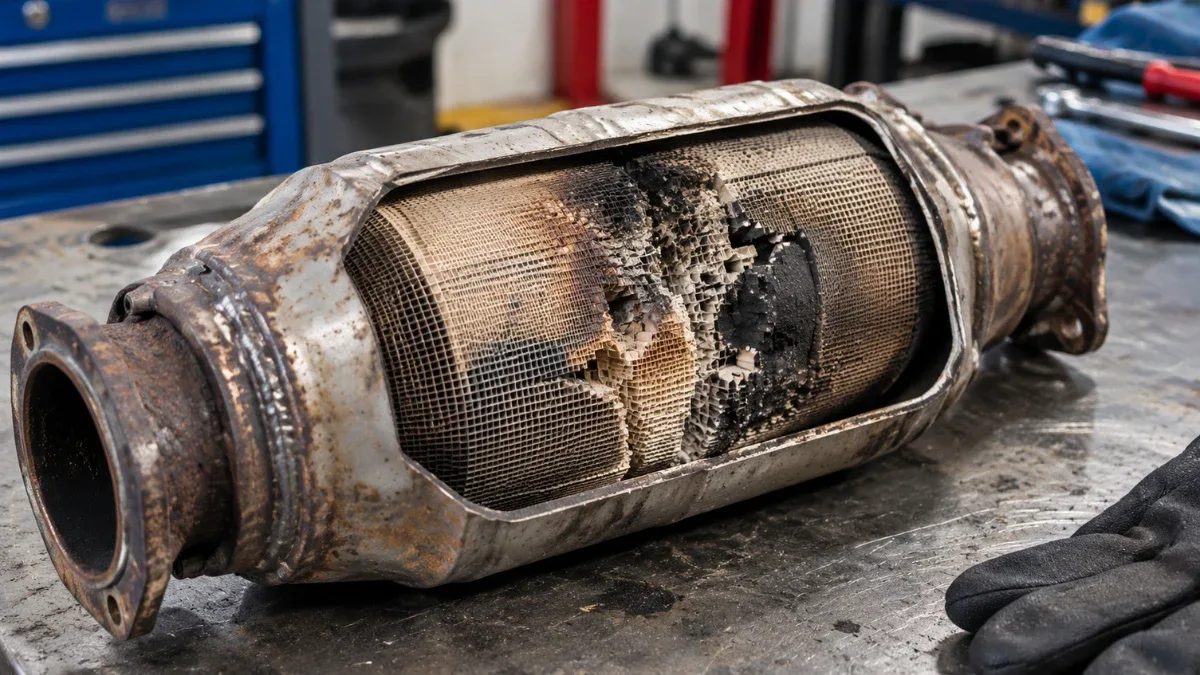
The second is physical damage or restriction. The internal honeycomb structure can crack, break apart, or melt from excessive heat. When exhaust flow becomes restricted, engine performance can suffer because the engine cannot expel exhaust gases properly.
That distinction explains why one vehicle may have little more than a warning light while another develops serious power loss.
The Main Bad Catalytic Converter Symptoms
Check Engine Light and Catalyst Efficiency Codes
A check engine light is often the first warning that something is wrong with the emissions system.
A code such as P0420 indicates that catalyst efficiency is below the expected threshold. P0430 serves a similar purpose for the other catalytic converter bank on applicable engines.
However, the code does not automatically prove that the converter itself has failed. Oxygen sensor problems, exhaust leaks, engine misfires, and fuel mixture issues can all affect the readings used by the engine computer.
This is why the code should be treated as a diagnostic clue rather than an instruction to replace the converter.
If the check engine light is flashing rather than steady, the situation is more urgent. An active engine misfire can send unburned fuel into the exhaust and create excessive heat that damages the catalytic converter. AutoSpecsHub explains the issue in more detail in its guide to a flashing check engine light.
Rotten Egg or Sulfur Smell
A strong sulfur or rotten egg smell coming from the exhaust is another classic warning sign.
The odor is associated with sulfur compounds in the exhaust system. A properly functioning emissions system helps process these compounds, while catalyst problems or an engine running with an incorrect air fuel mixture can produce a noticeable smell.
The odor alone is not enough to diagnose a failed converter. It becomes more meaningful when it appears together with a check engine light, poor performance, or other exhaust symptoms.
Loss of Power During Acceleration
A severely restricted catalytic converter can cause noticeable power loss.
You might find that the vehicle struggles to accelerate, feels unusually weak when climbing hills, or takes longer than normal to reach highway speeds. The problem can become more obvious when the engine is under heavy load.
This symptom deserves attention because restricted exhaust flow is only one possible cause. Ignition problems, fuel delivery issues, intake restrictions, and transmission faults can also produce poor acceleration.
If your vehicle is shaking when accelerating, for example, an engine misfire or another drivetrain problem may be involved rather than the catalytic converter alone.
Performance Gets Worse at Higher RPM
A partially restricted converter may not be obvious during gentle city driving.
As engine speed increases, however, the amount of exhaust that needs to leave the engine also increases. A restriction can therefore become more noticeable during hard acceleration, highway driving, or climbing a steep grade.
This pattern can be a useful diagnostic clue. A vehicle that feels relatively normal at low speeds but becomes increasingly weak as engine speed rises deserves an exhaust flow check along with the usual engine diagnostics.
Rattling From Underneath the Vehicle
A metallic rattling noise beneath the car can indicate physical damage inside the catalytic converter.
The internal ceramic substrate can crack or break apart. When that happens, pieces may move inside the converter housing and create a noticeable rattle, particularly during startup, idle, or changes in engine speed.
Not every exhaust rattle comes from the catalytic converter. Heat shields, exhaust brackets, pipes, and other components can make similar noises. The location and source of the sound therefore need to be confirmed before replacing anything.
Failed Emissions Testing
A catalytic converter is designed to reduce harmful pollutants in the exhaust, so an emissions test failure can be an important clue.
The failure may be related to catalyst efficiency, but other parts of the emissions system can also contribute. Oxygen sensors, fuel mixture problems, misfires, and exhaust leaks should be considered before the converter is condemned.
When an emissions failure appears alongside a catalyst efficiency code and other converter symptoms, the case for further catalyst testing becomes stronger.
Reduced Fuel Economy
A failing catalytic converter can sometimes be associated with declining fuel economy, but this is one of the least specific symptoms.
Changes in fuel economy can result from tire pressure, driving habits, fuel system problems, faulty sensors, ignition faults, or engine issues. A small drop in MPG by itself is therefore not a strong reason to suspect the converter.
It becomes more useful as part of a larger pattern, particularly when poor fuel economy occurs alongside a warning light, unusual exhaust odor, or noticeable loss of performance.
How to Tell a Bad Converter From Another Problem
This is where many simple symptom lists fall short.
Several problems can look like catalytic converter failure. An exhaust leak can influence oxygen sensor readings. A faulty oxygen sensor can affect catalyst monitoring. An engine misfire can damage the converter while also creating its own drivability symptoms.
The underlying engine condition matters too. Excessive oil consumption, coolant entering the combustion process, or an incorrect air fuel mixture can expose the converter to conditions that shorten its life.
A useful diagnostic approach usually considers:
What you notice | What it may suggest | What needs checking |
P0420 or P0430 | Low catalyst efficiency | Converter, oxygen sensors, exhaust leaks |
Rotten egg smell | Exhaust or catalyst issue | Converter and engine air fuel mixture |
Severe power loss | Possible exhaust restriction | Exhaust flow and engine performance |
Metallic rattling | Damaged internal substrate | Converter and surrounding exhaust |
Flashing check engine light | Active misfire | Ignition, fuel system, engine codes |
Failed emissions test | Emissions system problem | Converter, sensors, engine condition |
The important point is that one symptom rarely provides enough evidence on its own.
How a Catalytic Converter Is Properly Diagnosed
Diagnosis normally starts with an OBD II scan.
A technician can check stored and pending trouble codes and determine whether the vehicle has additional faults that could explain the catalyst reading. If a P0420 or P0430 code is present, the surrounding system needs to be evaluated rather than immediately replacing the converter.
The exhaust system should be inspected for leaks, while oxygen sensor operation and engine performance may also need to be checked. If restriction is suspected, exhaust flow or backpressure testing can provide additional evidence.
The exact diagnostic process depends on the vehicle and the type of failure.
A vehicle with a catalyst efficiency code but normal performance is a very different diagnostic case from one with severe power loss and evidence of restricted exhaust flow.
A trouble code is a starting point, not a diagnosis.
Can You Drive With a Bad Catalytic Converter?
It depends on what has failed.
A converter that has simply lost some of its emissions efficiency may cause very few noticeable driving problems. However, ignoring the issue indefinitely is still not a good idea because the underlying cause may continue to affect the vehicle.
A severely restricted converter is more concerning. Significant power loss, worsening acceleration, severe rattling, or rapidly developing symptoms should be investigated promptly.
A flashing check engine light deserves particular attention because an active misfire can generate enough heat to damage the catalytic converter and potentially create additional problems.
What Causes Catalytic Converters to Fail?
Catalytic converters are exposed to extreme temperatures and exhaust gases throughout their service life. Normal aging can eventually reduce their effectiveness, but many failures are caused or accelerated by another vehicle problem.
Common causes and contributing factors include:
Engine misfires
Incorrect air fuel mixture
Excessive oil consumption
Coolant contamination
Excessive exhaust temperatures
Physical damage
Exhaust system problems
This is one of the most important things to understand before replacing a converter.
If an engine problem caused the original converter to fail, installing a new converter without repairing that underlying fault can put the replacement at risk as well.
When Should the Catalytic Converter Be Replaced?
Replacement makes sense when testing confirms that the converter has genuinely failed, become physically damaged, or developed a significant restriction.
A P0420 or P0430 code alone should not automatically lead to replacement. The vehicle should first be checked for other faults that could produce the same result or cause premature converter failure.
Once replacement is confirmed, the correct converter needs to match the vehicle's engine, emissions configuration, model year, and applicable requirements.
For anyone evaluating a used vehicle, warning lights, unusual exhaust smells, strange noises, and engine performance should all be considered together. Used car checklist can help put those checks into a broader pre purchase inspection.
Frequently Asked Questions
What is the most common symptom of a bad catalytic converter?
A check engine light or catalyst efficiency code is one of the most common clues. Other symptoms can include sulfur smell, rattling, poor acceleration, emissions test failure, and reduced performance.
Does P0420 always mean the catalytic converter is bad?
No. P0420 indicates that the catalyst system is performing below the expected efficiency threshold. An oxygen sensor problem, exhaust leak, engine fault, or other issue can contribute to the code.
Can a bad catalytic converter cause loss of power?
Yes. A converter that becomes severely restricted can limit exhaust flow and cause noticeable power loss, particularly during acceleration, high engine speeds, or heavy loads.
Can a catalytic converter make a rattling noise?
Yes. A cracked or broken internal substrate can rattle inside the converter housing. Other exhaust components can produce similar sounds, so the source should be confirmed.
Can a bad catalytic converter affect fuel economy?
It can, particularly when the converter is restricted or another engine problem is occurring at the same time. However, poor fuel economy has many possible causes and should not be used alone to diagnose a converter.
How long can you drive with a bad catalytic converter?
There is no universal mileage limit. A mild efficiency problem may have little immediate effect on drivability, while a severely restricted converter can cause serious performance problems and should be inspected promptly.
The Right Diagnosis Matters More Than the Symptom List
Bad catalytic converter symptoms can point you in the right direction, but they do not tell the entire story.
A check engine light, sulfur smell, rattling noise, poor acceleration, or emissions failure can all be associated with a catalytic converter. They can also be caused by problems elsewhere in the engine or exhaust system.
The best approach is to look at the complete pattern, scan for trouble codes, inspect the related components, and identify the underlying cause before replacing an expensive emissions component.
That approach can save money and, just as importantly, help prevent the same problem from damaging another catalytic converter later.