
Ford F-150 Towing Capacity: Best Engines and Trims for Towing
Learn how the Ford F-150 towing capacity varies by engine, trim, and towing package. Compare the best configurations for hauling trailers, boats, and campers, and understand what to check before towing.
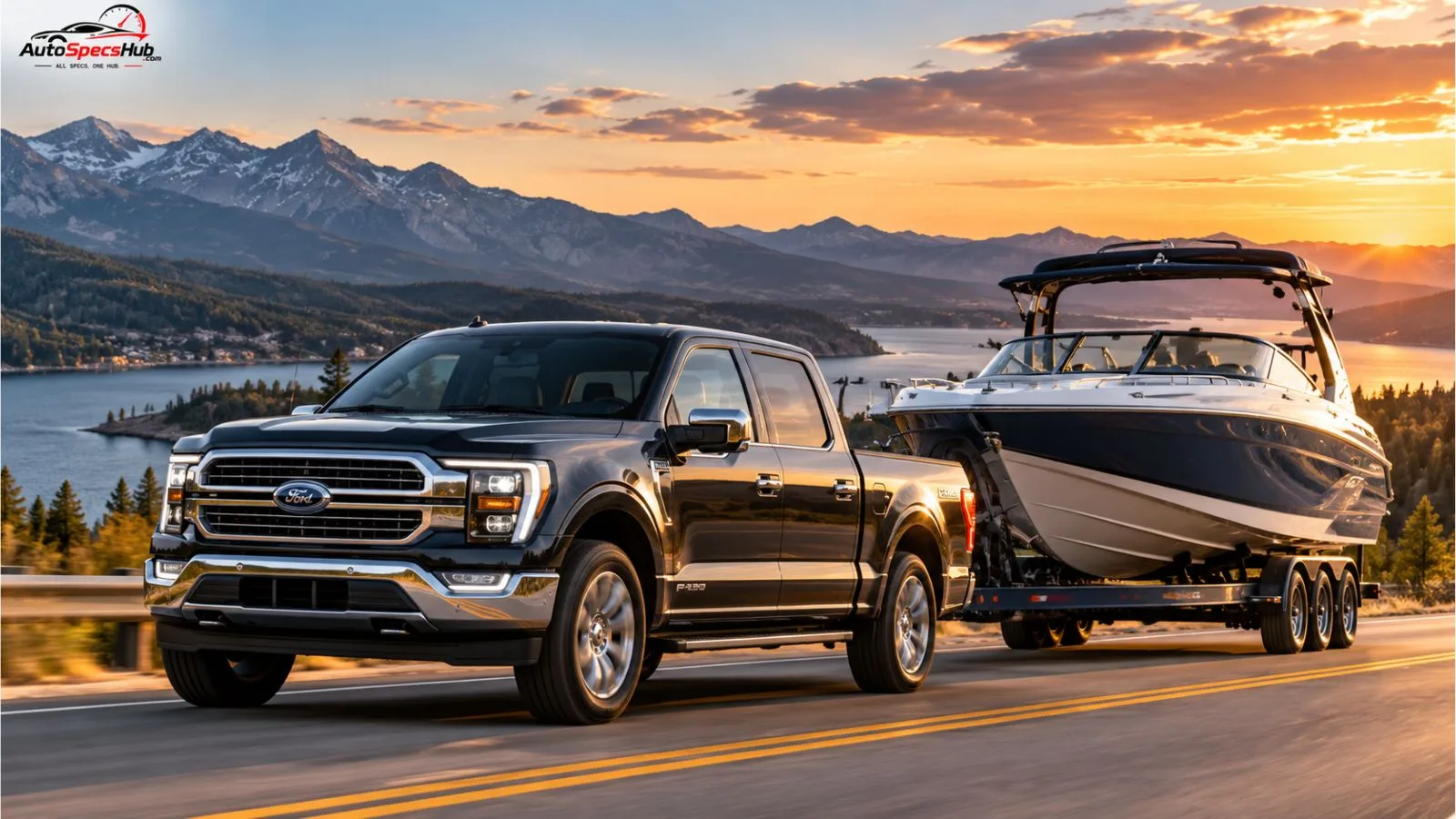
Choosing the right Ford F-150 for towing involves more than comparing horsepower or selecting the most expensive trim. Engine choice, cab configuration, drivetrain, axle ratio, and towing equipment all influence how much weight a truck can safely pull. A configuration suitable for a small boat may not be the right choice for a large travel trailer or heavy equipment.
The 2026 Ford F-150 offers several powertrains, including EcoBoost V6 engines, a traditional V8, a full hybrid V6, and specialized engines for the Raptor models. Each has different strengths, and the highest advertised towing capacity does not apply to every truck.
This guide explains Ford F-150 towing capacity by engine, identifies the configurations worth considering for different towing needs, and covers the equipment and weight limits you should understand before buying.
What Is the Maximum Ford F-150 Towing Capacity?
The 2026 Ford F-150 offers a maximum available conventional towing capacity of 13,500 pounds when properly equipped. This rating is available with selected configurations using the 3.5 liter EcoBoost V6 and the required towing equipment.
However, 13,500 pounds is the highest available rating, not the capacity of every F-150. Engine choice, cab style, drivetrain, axle ratio, accessories, passengers, and cargo can affect the rating that applies to an individual truck.
For comparison, Ford lists maximum available towing capacities of 8,400 pounds for the 2.7 liter EcoBoost V6, 12,800 pounds for the 5.0 liter V8, and 11,600 pounds for the PowerBoost hybrid V6. These figures provide a useful starting point when comparing engines, but they should not replace the rating for the exact configuration you plan to purchase.
Before choosing a truck, establish the fully loaded weight of your intended trailer. Then compare that weight with the truck's towing capacity, payload limit, and other applicable ratings. Selecting a vehicle based only on its advertised maximum can lead to an unsuitable configuration.
Ford F-150 Towing Capacity by Engine
The engine is one of the first factors to consider when comparing F-150 configurations. The following figures represent maximum available towing ratings for the 2026 model year. Actual capacity depends on the vehicle's configuration and required equipment.
2.7 Liter EcoBoost V6
The 2.7 liter EcoBoost V6 produces 325 horsepower and 400 lb ft of torque. Its maximum available towing capacity is 8,400 pounds.
This engine is worth considering for drivers who need a versatile pickup for everyday transportation, occasional recreational towing, and moderate trailer loads. It offers substantial capability without requiring the larger engines available in the lineup.
A properly configured F-150 with this engine may suit owners who tow smaller travel trailers, personal watercraft, lightweight boats, or utility trailers. However, the trailer's loaded weight and the truck's individual rating must be checked before towing.
The 2.7 liter engine may not be the right choice for a heavy trailer that approaches its maximum rating. If you regularly tow substantial loads, compare the larger powertrains and consider your expected cargo and passenger weight as well.
3.5 Liter EcoBoost V6
The 3.5 liter EcoBoost V6 is the leading option for buyers who prioritize maximum conventional towing capacity. It produces 400 horsepower and 500 lb ft of torque, and selected 2026 configurations can tow up to 13,500 pounds.
Reaching that maximum requires the appropriate configuration and equipment. Ford specifies the Tow Haul Package and optional Max Tow Axle for qualifying maximum towing setups.
The engine's strong torque output makes it appealing for larger travel trailers, substantial boat trailers, and other demanding applications within the truck's rated limits.
However, not every F-150 equipped with the 3.5 liter EcoBoost V6 can tow 13,500 pounds. Cab configuration, drivetrain, axle ratio, payload, and installed equipment all matter.
If towing is a major reason for buying the truck, this engine deserves close attention because it provides the highest available conventional towing rating in the standard F-150 lineup.
5.0 Liter Ti-VCT V8
The 5.0 liter V8 produces 400 horsepower and 410 lb ft of torque. Its maximum available towing capacity reaches 12,800 pounds in qualifying configurations.
This engine appeals to drivers who prefer a naturally aspirated V8 rather than a turbocharged powertrain. It provides a different driving character while retaining substantial towing capability.
For owners who regularly pull boats, enclosed trailers, or recreational equipment, the V8 can be a strong option. Its maximum rating is lower than the peak rating of the 3.5 liter EcoBoost V6, but that difference does not automatically make it the wrong choice.
Compare the specific trucks available to you, including their towing equipment, payload capacity, purchase price, and intended workload. If your trailer falls comfortably within the V8's verified rating, you may not need the engine with the highest advertised capacity.
3.5 Liter PowerBoost Full Hybrid V6
The PowerBoost combines a 3.5 liter EcoBoost V6 with an electric motor. For 2026, it produces 430 horsepower and 578 lb ft of torque, with a maximum available towing capacity of 11,600 pounds.
The hybrid system combines gasoline power with electric assistance, providing strong torque and additional functionality for drivers who want both towing capability and hybrid technology.
The PowerBoost is worth considering if you use your truck for commuting, work, recreational travel, and regular towing. Available Pro Power Onboard functionality can also provide electrical power for compatible tools and equipment.
Nevertheless, its maximum towing rating is lower than the highest rated 3.5 liter EcoBoost configuration. Buyers should compare the actual towing requirement with the truck's rating rather than assuming that the hybrid's higher horsepower automatically means a higher trailer limit.
Raptor Engines
The F-150 Raptor and Raptor R have specialized performance focused powertrains. They should not automatically be considered the best towing choices simply because they produce more horsepower.
The Raptor's high output 3.5 liter EcoBoost V6 produces 450 horsepower and has a maximum available towing rating of 8,200 pounds. The Raptor R uses a supercharged 5.2 liter V8 producing 720 horsepower, with a maximum available towing rating of 8,700 pounds.
These models prioritize high performance off road driving, specialized suspension equipment, and performance oriented engineering. Their towing ratings are below the maximum available rating of a properly equipped standard F-150.
If heavy trailer hauling is your primary objective, a conventional F-150 configured for towing may be a more suitable purchase than a Raptor.
Which Ford F-150 Engine Is Best for Towing?
The best engine depends on the weight of your trailer, how frequently you tow, and whether you use the truck for other purposes.
For maximum conventional towing: The 3.5 liter EcoBoost V6 is the strongest starting point. Its maximum available rating of 13,500 pounds makes it the leading option for buyers who need the highest available capacity.
For moderate recreational towing: The 2.7 liter EcoBoost V6 may be sufficient for lighter trailers and everyday driving. Confirm the loaded trailer weight before deciding that its rating provides enough capacity.
For a traditional V8: The 5.0 liter V8 offers a maximum available rating of 12,800 pounds. It is worth comparing with the EcoBoost engines if you prefer a naturally aspirated powertrain.
For hybrid capability: The PowerBoost provides strong output and up to 11,600 pounds of towing capacity. It suits buyers who want hybrid functionality, provided its rating matches their trailer requirements.
For specialized off road performance: The Raptor models have different priorities. Choose them for their performance characteristics rather than assuming they can tow more than a conventional F-150.
Before making a final decision, compare the exact model year and configuration rather than relying on engine names alone.
Which Ford F-150 Trim Is Best for Towing?
The trim level influences available equipment, but it does not determine towing capacity by itself. A higher trim is not automatically capable of towing more than a lower trim with the right engine and equipment.
XL and STX
The XL provides a practical starting point for buyers who prioritize capability over luxury features. It can be a suitable work truck when configured with the appropriate engine, axle, and towing equipment.
The STX adds distinctive styling and equipment. Buyers should still verify the available powertrain and package combinations before assuming it offers the same towing rating as another configuration.
XLT
The XLT deserves particular attention for buyers seeking a balance between everyday equipment and towing capability. Ford identifies an XLT SuperCrew 4x4 with a 6.5 foot bed, Tow Haul Package, and Max Tow Axle upgrade as its highest rated towing configuration in the 2026 lineup.
This does not mean every XLT reaches the maximum rating. The engine and exact equipment still determine the applicable limit.
Lariat, King Ranch, and Platinum
These trims offer additional comfort, convenience, and premium features. They may suit drivers who spend long hours traveling with a trailer and also use the truck for everyday transportation.
However, additional equipment and accessories can affect payload and the final towing rating. Compare the specifications of each configuration instead of paying more for a trim solely because it appears more capable.
Tremor and Raptor
The Tremor emphasizes off road capability, while the Raptor focuses on high performance driving in demanding terrain. Their specialized equipment can be valuable for their intended purposes, but buyers should check individual towing ratings before selecting one for regular heavy hauling.
For maximum conventional towing, a properly equipped standard F-150 may be a better match than a specialized off road model.
How Towing Packages Affect Capacity
Choosing the right engine is only part of the process. Towing packages and configuration details can determine whether a truck reaches its advertised maximum rating.
Ford specifies the Tow Haul Package and optional Max Tow Axle for certain maximum towing configurations. The required equipment must match the particular engine and vehicle setup.
Other factors include cab style, bed length, rear axle ratio, drivetrain, wheelbase, and installed accessories. A four wheel drive truck may have a different rating from a comparable rear wheel drive version.
When shopping for a used F-150, do not assume that the presence of a trailer hitch proves the truck has the equipment needed for its highest rating. Verify the original configuration and inspect the relevant documentation.
The same applies to other pickups, where towing capacity can vary by configuration, so it is important to check the exact setup rather than rely on the maximum advertised rating.
Four wheel drive can improve traction on different surfaces, but it does not automatically increase a truck’s rated towing capacity. If you are comparing pickup options, looking at how much a Ford Ranger can tow is a useful way to see how towing limits vary between trucks and configurations.
Towing Capacity vs. Payload Capacity
Towing capacity and payload capacity describe different limits. Towing capacity refers to the maximum permitted trailer weight for a particular configuration. Payload refers to the weight the truck can carry, including passengers, cargo, accessories, and the portion of trailer weight carried through the hitch.
This distinction matters because a truck can have a high towing rating but reach its payload limit before reaching that maximum trailer weight.
For example, a trailer places tongue weight on the truck. That weight counts toward payload along with the driver, passengers, tools, and other cargo. The truck must also remain within its gross vehicle weight rating and gross combined weight rating.
Ford lists a maximum available payload of 2,440 pounds for qualifying 2026 F-150 configurations. That figure does not apply to every truck, and maximum payload and maximum towing figures cannot necessarily be achieved simultaneously.
Before towing, check the payload label on the specific truck, the owner's manual, and the applicable towing guide. If the combined load exceeds any limit, reduce the load or choose a more suitable configuration.
How Much Can a Ford F-150 Tow in Real Life?
A truck's practical towing ability depends on the fully loaded trailer, the people and equipment inside the truck, and the conditions in which it will be driven.
A small boat or utility trailer may fit comfortably within the rating of a properly equipped F-150 with the 2.7 liter EcoBoost engine. Larger travel trailers or heavier equipment may call for a configuration with more towing capacity, such as the 3.5 liter EcoBoost V6.
Do not calculate your needs using the empty weight of a trailer alone. Water, fuel, luggage, camping equipment, and other cargo can increase its total weight substantially.
Also consider where you will tow. Long highway journeys, steep grades, hot weather, and frequent stops can place additional demands on the vehicle. Appropriate trailer brakes, tires, hitch equipment, and weight distribution are important when required for the particular setup.
The safest approach is to select a truck that meets the actual loaded trailer requirements while remaining within all vehicle and trailer limits.
How to Find Your F-150's Exact Towing Rating
Before purchasing or towing with an F-150, confirm the rating for the exact vehicle.
Start with Ford's towing guide for the correct model year. Identify the engine, cab style, bed length, drivetrain, axle ratio, and required towing package. Then compare those details with the truck's documentation and equipment.
Check the vehicle's payload label and owner's manual as well. These help establish whether passengers, cargo, and trailer tongue weight will remain within the truck's limits.
If you are buying used, ask the seller for the vehicle identification number and verify the original equipment. If the configuration or rating cannot be confirmed, do not assume that the highest published figure applies.
Frequently Asked Questions
Which Ford F-150 engine has the highest towing capacity?
For the 2026 model year, the 3.5 liter EcoBoost V6 has the highest available conventional towing rating, reaching 13,500 pounds in a properly equipped configuration.
Is the V8 better than the V6 for towing?
Not necessarily. The 5.0 liter V8 reaches up to 12,800 pounds, while the 3.5 liter EcoBoost V6 reaches up to 13,500 pounds. The best option depends on the exact configuration and your preferences.
Is the hybrid F-150 good for towing?
Yes. The PowerBoost hybrid has a maximum available towing capacity of 11,600 pounds. It is worth considering if you want strong torque and hybrid functionality, provided its rating suits your trailer.
Does a higher trim always tow more?
No. Engine, axle ratio, drivetrain, cab and bed configuration, and towing equipment can matter more than the trim name alone.
Can every F-150 tow 13,500 pounds?
No. That is the maximum available rating for specific configurations. Always verify the towing capacity of the exact truck you intend to use.
Final Thoughts
The Ford F-150 offers several engines and configurations for different towing needs. The 2.7 liter EcoBoost V6 suits lighter loads, the 5.0 liter V8 provides a traditional alternative, and the PowerBoost hybrid combines strong output with hybrid functionality. For buyers who need the highest available conventional towing capacity, the 3.5 liter EcoBoost V6 is the leading choice.
The right trim depends on the equipment you need, but no trim name guarantees a particular towing rating. Compare the engine, axle, drivetrain, cab, bed, and towing package before deciding which truck to buy.
Most importantly, use the rating for your exact configuration and account for payload, passengers, cargo, and loaded trailer weight. With those details confirmed, you can choose a Ford F-150 that suits your towing requirements without exceeding its limits.