
Toyota 4Runner Towing Capacity: Specs, Limits and Towing Guide
Learn about Toyota 4Runner towing capacity, including maximum towing limits, engine and trim differences, payload considerations, hitch requirements, and what you need to know before towing with a 4Runner.
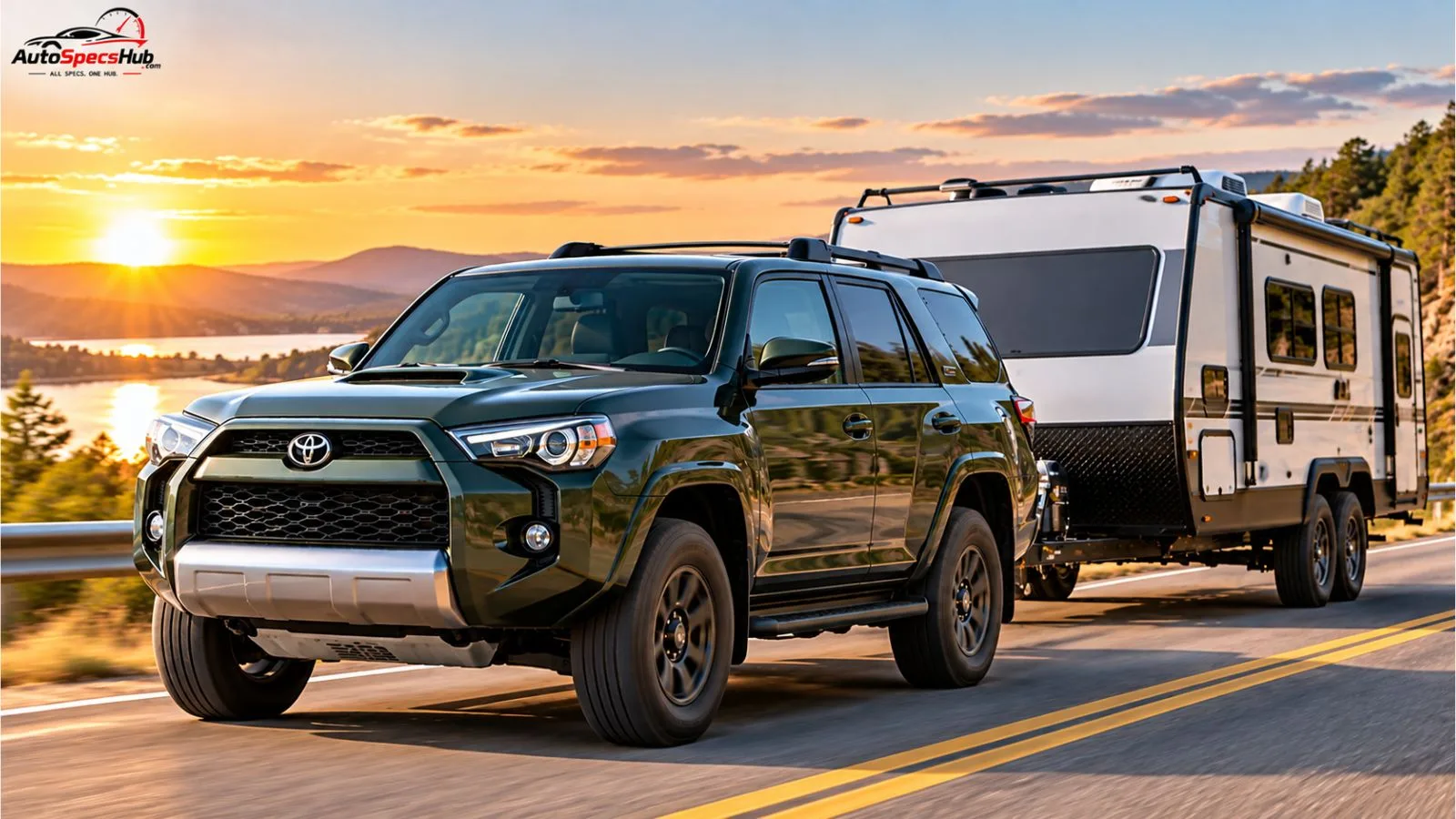
The Toyota 4Runner has long been known for its body-on-frame construction, four-wheel-drive capability, and utility. Towing is another important part of its appeal, but the amount it can safely pull depends on the model year, engine, drivetrain, trim, and equipment.
For the latest sixth-generation 4Runner, Toyota lists a maximum towing capacity of 6,000 pounds. The fifth-generation 4Runner, sold through 2024, was generally rated at 5,000 pounds. Certain fourth-generation models could offer substantially different ratings, including up to 7,300 pounds in specific V8 configurations. That history makes it important to identify the exact 4Runner before choosing a trailer.
Toyota 4Runner Towing Capacity at a Glance
The headline towing figure has changed over the 4Runner's history. The current 2025 and 2026 4Runner reaches a maximum of 6,000 pounds, while the 2010–2024 fifth-generation model is generally rated at 5,000 pounds. Earlier fourth-generation models had a wider range depending on engine and drivetrain.
For the current generation, the standard 2.4-liter turbocharged four-cylinder powertrain is rated for up to 5,000 pounds in the SR5 and TRD Off-Road configurations. The available i-FORCE MAX hybrid powertrain raises the maximum to 6,000 pounds on applicable configurations. Toyota also provides Trailer Back Up Guide, Straight Path Assist, and an available trailer brake controller.
Always verify the exact rating for the vehicle, model year, and configuration you are considering.
2025 and 2026 Toyota 4Runner Towing Capacity
The sixth-generation 4Runner brought a major change to the model's towing capability. Toyota states that the redesigned 4Runner can tow up to 6,000 pounds, an increase over the 5,000-pound maximum of the previous generation.
The standard 2.4-liter i-FORCE turbo engine is used in the SR5 and TRD Off-Road. These configurations are rated at up to 5,000 pounds. The i-FORCE MAX hybrid combines the turbocharged engine with an electric motor and is available on higher trims. Those hybrid configurations can reach the 6,000-pound maximum.
Toyota also equips the current 4Runner with features designed to make towing easier. Available equipment includes a trailer brake controller, Trailer Back Up Guide with Straight Path Assist, and towing-related camera and blind-spot features. These systems can improve visibility and control, but they do not change the vehicle's official weight limits.
5th-Generation 4Runner Towing Capacity
The fifth-generation 4Runner covered model years 2010 through 2024 and used a 4.0-liter V6 for most of its production run. Its maximum towing capacity was generally 5,000 pounds.
That figure is useful when comparing the older 4Runner with the redesigned sixth generation. If you are buying a 2015, 2018, 2021, or 2024 model, do not assume that the newer 6,000-pound rating applies. The fifth-generation vehicle has its own specifications and limits.
Trim and equipment can also affect the practical amount of weight you can carry while towing. Passengers, luggage, aftermarket accessories, and trailer tongue weight all count against the vehicle's available payload. A trailer below the headline 5,000-pound towing figure can still push the tow vehicle beyond another applicable limit if it is heavily loaded.
4th-Generation 4Runner Towing Capacity
The fourth-generation 4Runner, sold from 2003 through 2009, is especially interesting because its towing capability varied significantly by configuration. Certain V8-equipped models were rated as high as 7,300 pounds with appropriate equipment, while other versions were rated lower.
This generation shows why model year and engine information are essential when researching used 4Runners. A V8 model from this era should not be treated as equivalent to a V6 model simply because both carry the 4Runner name.
Vehicle condition, maintenance, tires, brakes, suspension components, hitch equipment, and cooling-system condition can all affect towing safety. A used vehicle should be inspected carefully before being asked to tow near its maximum rating.
What Determines Toyota 4Runner Towing Capacity?
Towing capacity is not determined by engine horsepower alone. Manufacturers consider the complete vehicle, including the engine, transmission, cooling system, brakes, suspension, chassis, drivetrain, axle ratings, and hitch equipment.
Engine and drivetrain are still important. A stronger powertrain can provide more capability, but the final rating is established by the complete vehicle configuration.
The model year is another major factor. As the 4Runner changed generations, Toyota changed its engines, chassis, technology, and towing specifications. This is why a 2007 4Runner, a 2017 4Runner, and a 2026 4Runner should be researched separately.
Gearing also plays an important role when towing, as lower gears can provide more torque multiplication and help the vehicle manage heavier loads.
Payload vs. Towing Capacity
One of the most important towing concepts is the difference between trailer weight and payload. Towing capacity refers to the maximum trailer weight a vehicle is rated to pull. Payload is the weight the 4Runner itself can carry, including passengers, cargo, accessories, and trailer tongue weight.
Tongue weight is the downward force the trailer places on the hitch. It becomes part of the load carried by the 4Runner. This means a vehicle can be below its maximum trailer rating while still exceeding its payload or axle limits.
For example, imagine a trailer that weighs close to the 4Runner's maximum towing rating. Add several passengers, camping equipment, recovery gear, luggage, and other accessories, and the vehicle's available payload can disappear quickly. Check your specific vehicle limits before towing.
Understanding GVWR and GCWR
Two other numbers matter when calculating a towing setup: GVWR and GCWR.
GVWR, or Gross Vehicle Weight Rating, is the maximum allowable loaded weight of the tow vehicle itself. It includes passengers, cargo, fuel, accessories, and tongue weight.
GCWR, or Gross Combined Weight Rating, covers the combined loaded weight of the vehicle and trailer. Staying within both limits is important because towing capacity alone does not describe the entire combination.
You should also consider the front and rear axle ratings, the hitch rating, the trailer's rating, and the tires. The lowest applicable limit can become the practical restriction for the complete setup.
Does the 4Runner Need a Tow Package?
The exact towing equipment depends on the model year and trim. Current 4Runner models are designed with towing capability in mind, and Toyota provides factory towing equipment and available features that support trailer use.
A properly rated receiver hitch is essential. Trailer wiring is also required for the trailer's lights and other electrical functions. If the trailer uses electric brakes, a compatible brake controller and properly functioning trailer brakes are important.
Do not assume that installing an aftermarket hitch automatically increases the vehicle's towing capacity. A hitch is only one part of the towing system. The vehicle, receiver, wiring, brakes, tires, and trailer all need to be suitable for the load.
How Much Can a Toyota 4Runner Tow?
For the latest generation, the answer depends on the powertrain. The maximum is 6,000 pounds, while certain standard-powertrain configurations are rated at 5,000 pounds.
For the fifth generation, the commonly published maximum is 5,000 pounds. Older fourth-generation models can vary considerably, with certain V8 configurations reaching 7,300 pounds.
These figures are maximum ratings, not targets for every trip. A trailer's loaded weight should be measured or reliably established before towing. Dry trailer weight can be misleading because water, fuel, batteries, propane, tools, luggage, and recreational equipment add weight.
What Can a 4Runner Tow?
A properly configured 4Runner can be used for many recreational and utility trailers. Depending on the trailer's actual loaded weight, examples can include small boats, personal watercraft, utility trailers, motorcycle trailers, ATVs, small campers, and some travel trailers.
Two trailers in the same category can have very different loaded weights. A small-looking camper can become much heavier once water, batteries, propane, food, equipment, and personal belongings are added.
Before towing, determine the trailer's ready-to-travel weight and compare it with the exact limits of your 4Runner.
Towing Safety Checklist
Before every towing trip, inspect the complete setup.
Confirm the loaded trailer weight and make sure it is within the vehicle's rated towing capacity. Check the tongue weight and ensure the tow vehicle remains within its payload and axle limits. Inspect the hitch connection and make sure the coupler is fully locked.
Connect and secure the safety chains. Test the trailer lights and electric brakes if fitted. Check tire pressure and condition on both the 4Runner and trailer.
Load the trailer so its weight is distributed appropriately and the cargo is secured. Allow more braking distance than you would when driving without a trailer. Reduce speed when conditions require it, particularly in strong winds, heavy rain, or on steep roads.
The right gear ratio can help a vehicle maintain useful engine power and torque when accelerating with a trailer, while also influencing engine speed and fuel economy.
How to Find Your Exact 4Runner Towing Limit
The safest way to determine your 4Runner's exact towing limit is to identify the model year, engine, drivetrain, trim, and factory equipment. Then consult the vehicle's owner's manual and certification labels.
Do not rely only on a generic towing number found in a listing or advertisement. Used 4Runners can have different specifications depending on their original configuration and model year.
Also check the vehicle's door-jamb information for weight ratings and compare those figures with the trailer's actual loaded weight. If uncertain, a qualified Toyota dealer or towing specialist can verify the vehicle's factory configuration and limits.
Toyota 4Runner Towing Capacity FAQs
What is the maximum Toyota 4Runner towing capacity?
The current 4Runner has a maximum towing capacity of 6,000 pounds. The exact rating depends on the powertrain and configuration.
How much can a 2025 or 2026 4Runner tow?
The latest generation can tow up to 6,000 pounds. Some standard turbo-four configurations are rated at 5,000 pounds, while applicable i-FORCE MAX hybrid versions reach 6,000 pounds.
Can a 4Runner tow a camper?
Yes, a properly configured 4Runner can tow campers, but the camper's loaded weight must remain within the vehicle's towing, payload, hitch, axle, and combined-weight limits.
Is the 4Runner good for towing?
The 4Runner is designed with towing capability as part of its utility-focused package. Its body-on-frame platform and available four-wheel-drive systems make it suitable for a range of trailer applications, provided the load stays within the vehicle's ratings.
Does a heavier trim always tow more?
No. Additional equipment can increase vehicle weight and reduce available payload. The highest trim is not automatically the highest-rated towing configuration.
Final Thoughts
Toyota 4Runner towing capacity has changed significantly across generations. The latest 2025 and 2026 models can tow up to 6,000 pounds, while the fifth-generation 4Runner generally tops out at 5,000 pounds. Certain fourth-generation V8 models had much higher historical ratings. Towing also changes how the 4Runner accelerates, brakes, corners, and responds to crosswinds. A comfortable setup leaves reasonable margin below the published limits instead of treating the maximum rating as an everyday target when possible.
The most important lesson is to avoid treating the 4Runner's headline towing number as the only limit. Model year, engine, drivetrain, payload, tongue weight, GVWR, GCWR, axle ratings, hitch equipment, trailer brakes, and actual trailer weight all matter.
If you are choosing a 4Runner specifically for towing, start with the trailer you need to pull and work backward to the vehicle configuration that meets every applicable limit. That approach gives you a more accurate picture of what the 4Runner can safely and comfortably handle than simply comparing maximum towing numbers.