
What Is a Gear Ratio? How Transmission Gearing Affects Your Car
What is a gear ratio? Learn how transmission gearing works, how gear ratios affect acceleration, fuel economy, top speed, towing, engine RPM, and everyday driving performance.
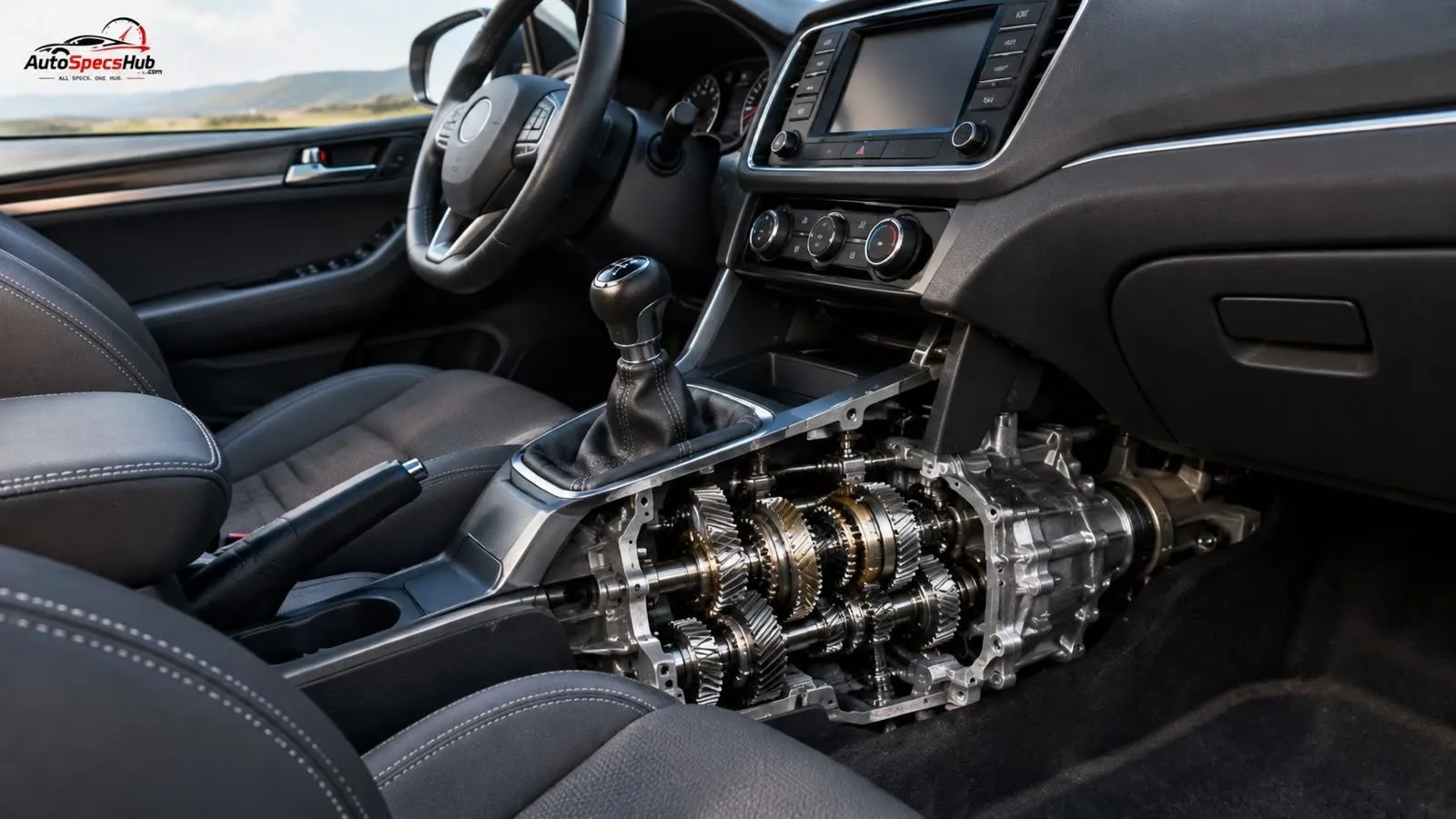
A gear ratio is one of the fundamental parts of a car’s drivetrain, but many drivers never think about it until they notice how differently two vehicles accelerate, cruise, or handle hills. The basic idea is simple: a gear ratio determines how many times one gear turns compared with another. In a vehicle, these ratios help control how engine power is delivered to the wheels at different speeds.
Transmission gearing has a direct effect on engine RPM, acceleration, fuel economy, towing ability, and everyday driving. A low gear provides the torque multiplication needed to move a vehicle from a stop, while a higher gear allows the engine to turn more slowly as road speed increases. Understanding this relationship makes it easier to see why cars use multiple gears and how transmission design influences the way a vehicle performs.
What Is a Gear Ratio?
A gear ratio describes the relationship between two gears and how their rotational speeds compare. It can be calculated using the number of teeth on the gears.
For example, imagine a small gear with 10 teeth driving a larger gear with 30 teeth. The smaller gear must rotate three times for the larger gear to complete one rotation. This creates a 3:1 gear ratio.
Cars use the same basic principle to control the relationship between engine speed and wheel speed. The transmission changes this relationship by selecting different gear ratios as the vehicle accelerates.
A gear ratio does not create additional engine power. Instead, it changes how the available torque and rotational speed are delivered through the drivetrain.
Why Do Cars Need Different Gear Ratios?
An engine does not operate equally efficiently or produce the same amount of useful power at every RPM. Different transmission gears allow the engine to remain within a suitable operating range as vehicle speed changes.
When a car starts from a standstill, it needs considerable torque at the wheels. The transmission therefore uses a lower gear to multiply engine torque. As the vehicle accelerates, the transmission shifts into progressively higher gears.
At highway speeds, the engine does not need the same torque multiplication required to get the vehicle moving. A higher gear can therefore reduce engine RPM while allowing the wheels to continue turning quickly.
This balance between torque and rotational speed is the main reason modern vehicles use multiple transmission ratios.
How Does a Gear Ratio Work in a Car?
The easiest way to understand automotive gearing is to compare a low gear with a high gear.
A low gear provides greater torque multiplication but limits wheel speed relative to engine RPM. It is useful when starting, accelerating strongly, climbing hills, or moving heavy loads.
A high gear provides less torque multiplication but allows the wheels to rotate faster relative to the engine. It is generally used once the vehicle has reached higher speeds and needs to maintain momentum efficiently.
For example, a transmission might use ratios similar to these:
Gear | Example Ratio | Typical Use |
|---|---|---|
1st | 3.50:1 | Starting and strong acceleration |
2nd | 2.10:1 | Low-speed acceleration |
3rd | 1.40:1 | Moderate-speed driving |
4th | 1.00:1 | Direct-drive relationship |
5th | 0.80:1 | Higher-speed cruising |
6th | 0.65:1 | Efficient highway driving |
These figures are examples rather than specifications for a particular vehicle. Actual ratios vary depending on the engine, transmission, drivetrain, vehicle weight, and intended use.
What Does a Low Gear Ratio Do?
A low transmission gear increases the amount of torque available at the transmission output.
For example, if an engine produces 200 lb-ft of torque and first gear has a 3.50:1 ratio, the transmission can theoretically multiply that torque to about 700 lb-ft at its output before accounting for final-drive gearing and drivetrain losses.
This additional torque helps the vehicle overcome its initial resistance and accelerate from a standstill.
The trade-off is that the engine must rotate much faster than the transmission output. If the vehicle remained in first gear as its speed increased, engine RPM would quickly climb toward the engine's operating limit.
The transmission therefore shifts into a higher gear to reduce the amount of torque multiplication and allow the vehicle to continue accelerating.
What Does a High Gear Ratio Do?
There is an important terminology distinction when discussing high gears.
Drivers commonly refer to first gear as a low gear and sixth or seventh gear as a high gear. Numerically, however, the ratio of a high transmission gear is usually lower.
For example, first gear might have a ratio of 3.50:1, while a cruising gear could have a ratio of 0.70:1.
A high transmission gear reduces engine RPM relative to vehicle speed. This is particularly useful during highway driving because the engine can maintain road speed without spinning as quickly.
Many vehicles use overdrive gears, where the transmission output rotates faster than the input. These gears are primarily designed to reduce engine speed during cruising.
How Gear Ratios Affect Acceleration
Gear ratios have a major influence on how a vehicle accelerates.
Lower gears multiply engine torque more strongly, giving the driven wheels greater turning force. This is why a vehicle generally feels more responsive in first and second gear than in a high cruising gear.
As the transmission shifts upward, torque multiplication decreases. However, the engine may remain in a more useful RPM range, allowing the vehicle to continue gaining speed.
Performance vehicles often use closely spaced gear ratios to keep the engine near its strongest power range between shifts. Other vehicles may use taller gearing to emphasize relaxed cruising and fuel efficiency.
This is why horsepower alone cannot describe how quickly a vehicle accelerates. Transmission gearing, final-drive ratio, vehicle weight, tire size, traction, and drivetrain losses all contribute to the result.
Gear Ratios and Engine RPM
The selected gear determines how quickly the engine rotates at a particular road speed.
At the same vehicle speed, a lower gear will generally produce higher engine RPM than a higher gear. Moving into a higher gear allows the engine to slow down while maintaining the same road speed.
For example, a vehicle traveling at highway speed might operate at relatively high RPM in third gear but much lower RPM in sixth gear.
This relationship is one reason modern transmissions have increasingly large numbers of forward gears. More ratios give the transmission additional opportunities to keep the engine operating in an appropriate range.
How Gear Ratios Affect Fuel Economy
Gearing can have a significant effect on fuel consumption, particularly during steady-speed driving.
A taller cruising gear can reduce engine RPM, which may help lower fuel consumption when the vehicle requires relatively little power to maintain speed.
However, taller gearing is not automatically more efficient in every situation. If a gear is too tall for the road conditions or vehicle load, the engine may need to work harder or the transmission may need to downshift.
Modern automatic transmissions constantly evaluate factors such as vehicle speed, throttle position, engine load, and road conditions when selecting the appropriate ratio.
Gear Ratios and Towing
Gear ratios are especially important for vehicles that regularly tow trailers.
Moving a heavy trailer from a standstill requires substantial torque at the wheels. A lower gear increases torque multiplication and helps the vehicle get moving without placing unnecessary strain on the drivetrain.
During towing, the transmission may also hold lower gears longer to maintain engine RPM and reduce unnecessary shifting.
The final-drive ratio is important as well. Transmission gearing and final-drive gearing work together to determine the overall torque delivered to the wheels.
For buyers comparing vehicles for towing, it is therefore useful to consider the entire drivetrain rather than looking only at horsepower or maximum torque.
What Is a Final Drive Ratio?
The transmission is only one part of the vehicle's gearing system.
After power leaves the transmission, it normally passes through the final drive, which provides another gear reduction before reaching the wheels.
For example, if a transmission is operating at 1.00:1 and the final-drive ratio is 3.50:1, the overall ratio is 3.50:1 before accounting for other drivetrain factors.
If the transmission uses a 0.70:1 cruising gear with the same final drive, the overall ratio becomes 2.45:1.
The final drive therefore influences acceleration, cruising RPM, and the overall character of the vehicle.
Gear Ratio vs Final Drive Ratio
The transmission gear ratio changes whenever the transmission shifts between gears. The final-drive ratio is generally a fixed reduction that remains the same regardless of which transmission gear is selected.
Together, they determine the overall relationship between engine rotation and wheel rotation.
This helps explain why two vehicles with similar engines can feel noticeably different. Their transmission and final-drive configurations may have been designed around different priorities, such as acceleration, fuel economy, towing, or highway cruising.
How Gear Ratios Affect Top Speed
Gearing can influence the theoretical maximum speed of a vehicle.
Shorter gearing can produce strong acceleration but may cause the engine to reach its maximum RPM sooner. Taller gearing can allow a vehicle to continue accelerating to a higher speed before reaching the engine's RPM limit.
However, the highest possible speed is not determined by gearing alone.
Aerodynamic drag, available engine power, vehicle weight, tire limitations, electronic restrictions, and other factors can become more important as speed increases.
In many vehicles, the highest gear is designed primarily for efficient cruising rather than maximum speed.
Manual vs Automatic Transmission Gearing
Manual and automatic transmissions both use gear ratios, but they manage them differently.
In a manual transmission, the driver chooses when to change gears. This gives the driver direct control over engine RPM and the relationship between engine speed and road speed.
An automatic transmission selects ratios according to driving conditions. Modern automatic transmissions may have eight, nine, or even more forward gears, allowing relatively small changes between ratios.
A CVT works differently because it can continuously vary its effective ratio rather than relying on a fixed set of conventional gears.
For a closer explanation of these differences, CVT vs automatic transmission covers how the two systems compare in gearing, driving feel, fuel economy, and maintenance.
What Are Close-Ratio and Wide-Ratio Transmissions?
A close-ratio transmission has relatively small differences between consecutive gears.
This allows engine RPM to remain within a narrower range after each shift. It can be useful in performance applications where maintaining the engine's operating range during acceleration is important.
A wide-ratio transmission has larger differences between its gears.
This can provide a broader range between low-speed torque multiplication and relaxed highway cruising. Such gearing can be useful in vehicles that need versatility across different driving conditions.
Neither approach is universally suitable for every vehicle because manufacturers choose ratios according to the vehicle's intended purpose.
Do Bigger Tires Change the Effective Gear Ratio?
Yes. Changing tire diameter can alter the effective gearing between the engine and road.
A larger-diameter tire travels farther with each rotation. At a given road speed, this can reduce engine RPM compared with a smaller tire.
However, larger tires can also reduce the effective torque multiplication at the wheels. Depending on the vehicle, this may make acceleration feel less responsive.
This is why tire size matters when evaluating drivetrain modifications or comparing vehicles with different wheel and tire configurations.
Why Gear Ratios Matter When Comparing Cars
Gear ratios can help explain differences between vehicles that appear similar on paper.
Two vehicles may have comparable horsepower and torque but deliver different driving experiences because their transmission ratios, final-drive ratios, weights, tire sizes, and drivetrain configurations are different.
When researching a vehicle, looking at detailed vehicle specifications can help you compare the engine, transmission, drivetrain, dimensions, and other mechanical details rather than focusing on one specification alone.
This is particularly useful when comparing performance cars, family vehicles, SUVs, and vehicles intended for towing.
Common Questions About Gear Ratios
Is a higher gear ratio better?
Not necessarily. Each ratio serves a different purpose. Lower gears provide stronger torque multiplication, while higher transmission gears generally reduce engine RPM during cruising.
Does a higher gear ratio mean faster acceleration?
Not by itself. Acceleration depends on the complete gearing system, engine output, vehicle weight, traction, and operating conditions.
Does gear ratio affect fuel economy?
Yes. Taller gearing can reduce engine RPM during steady-speed driving and may contribute to better fuel economy, although engine efficiency and driving conditions also have a major influence.
Why does my car downshift when climbing a hill?
A transmission may downshift because the engine needs additional torque at the wheels. The lower gear increases torque multiplication and allows the engine to operate at a higher RPM.
Do electric cars use gear ratios?
Many electric cars use a single-speed reduction gear instead of a conventional multi-speed transmission. Electric motors can operate across a wide RPM range, reducing the need for multiple traditional gears. Some electric vehicles do use multi-speed transmissions.
Final Thoughts
A gear ratio determines how engine rotation is converted into wheel speed and torque, making it a fundamental part of a vehicle's drivetrain. Lower gears provide the torque multiplication needed for starting, acceleration, climbing, and towing, while higher transmission gears allow the engine to operate at lower RPM during faster cruising.
Understanding gearing also shows why horsepower and torque figures alone do not tell the complete story about how a vehicle performs. Transmission ratios, final-drive gearing, tire dimensions, vehicle weight, and engine characteristics all contribute to the way a car accelerates, cruises, consumes fuel, and handles different loads. Once these relationships are understood, transmission specifications become much easier to interpret when comparing different vehicles.