
What Is a Transfer Case? How It Works and Why Your 4WD Depends on It
What is a transfer case? Learn how it works, what 2H, 4H and 4L mean, how it differs from a differential, and the signs of transfer-case problems.
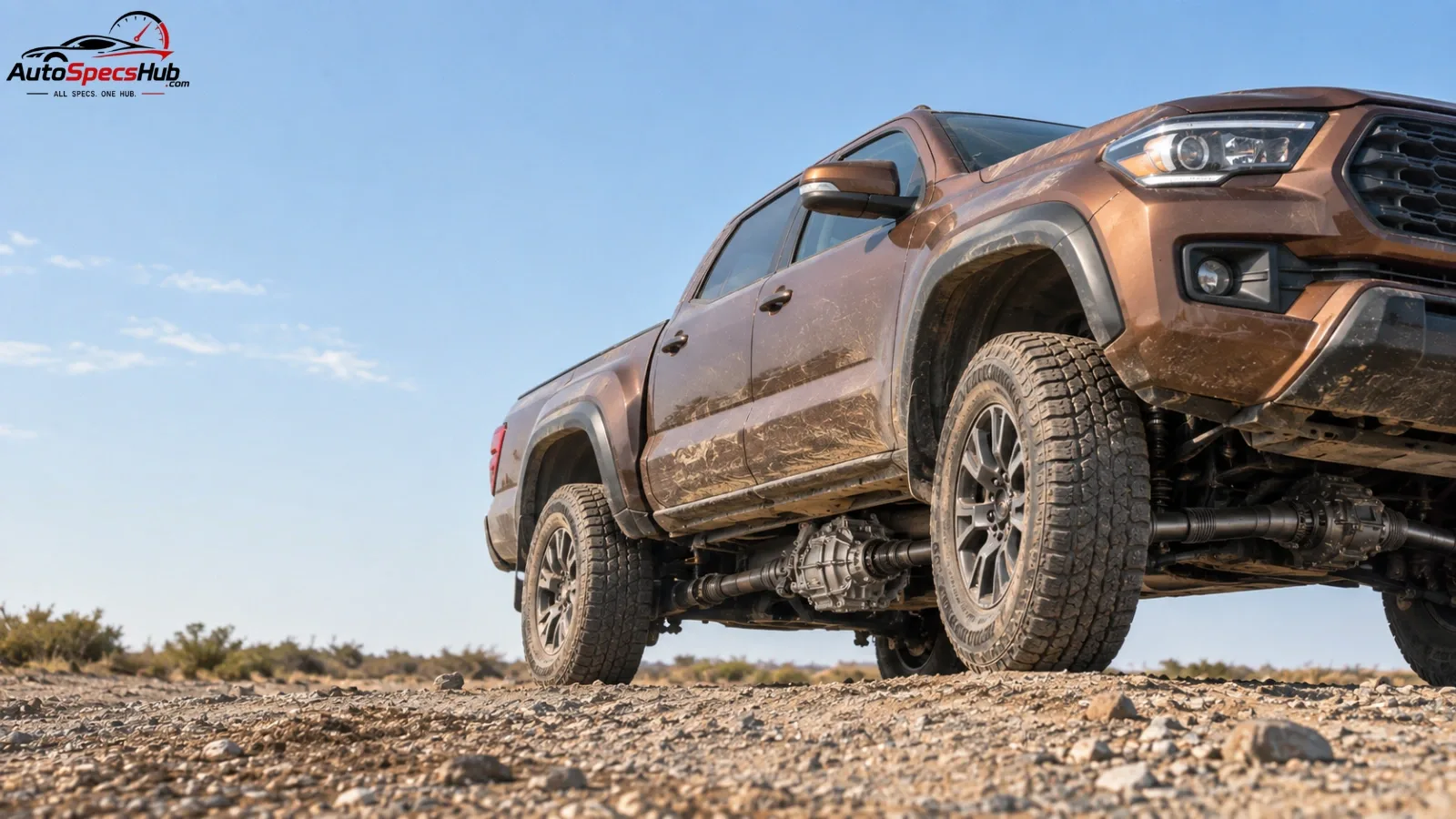
A transfer case is the drivetrain component that helps many 4WD vehicles send power to both the front and rear axles. Depending on the design, it can also provide selectable drive modes and low-range gearing for slow, demanding terrain.
So, what is a transfer case on a car? In a traditional 4WD layout, it sits behind the transmission and manages how engine power is delivered to the front and rear drivetrains. But modern AWD systems can work differently, and not every AWD vehicle uses a conventional transfer case.
Understanding how the transfer case fits between the transmission, driveshafts and differentials makes it much easier to understand 4WD modes, low range, common transfer-case problems and maintenance.
What Is a Transfer Case?
A transfer case is a drivetrain assembly that receives power from the transmission and, in traditional 4WD layouts, provides separate outputs for the front and rear drivetrains. It is commonly mounted behind the transmission in trucks and SUVs designed for four-wheel drive.
A simplified power path looks like this:
Engine → Transmission → Transfer Case → Driveshafts → Differentials → Wheels
The transfer case can perform several functions depending on the vehicle:
Send power to both front and rear drivetrains
Allow the driver to select different 4WD modes
Provide high- and low-range gearing
Use a center differential or other mechanism on certain systems
Work with electronic controls to manage drivetrain operation
Traditional transfer cases can use gears, chains, clutches or combinations of mechanical and electronic components. Their design varies significantly between vehicles.
That is why there isn't one universal transfer-case layout. A basic 4WD truck and a sophisticated AWD SUV may achieve similar traction goals using very different hardware.
Where It Sits in the Drivetrain
The transfer case makes more sense when you separate its job from the other major drivetrain components.
The transmission changes the gear ratio between the engine and drivetrain, allowing the vehicle to operate across a wide range of speeds and loads.
The transfer case receives that transmission output and manages how power is delivered between the vehicle's driven axles. In many 4WD systems, it also provides low-range gearing.
The differentials allow wheels connected to the same axle to rotate at different speeds, which is essential when the vehicle turns.
In simple terms:
Transmission: manages gearing between the engine and drivetrain.
Transfer case: manages power between front and rear drivetrains and may provide low range.
Differential: manages differences in wheel speed across an axle.
This distinction is important because a transfer case and differential are not interchangeable components.
It also explains why AWD and 4WD aren't simply different names for exactly the same system. Their hardware and control strategies can vary considerably. For a broader look at those drivetrain layouts, see our FWD vs AWD drivetrain comparison.
What Does a Transfer Case Actually Do?
The transfer case has more than one job, and its exact function depends on the vehicle.
It can drive both axles
In a traditional part-time 4WD system, selecting four-wheel drive connects the front drivetrain so that both front and rear axles receive engine torque.
This can improve the vehicle's ability to maintain forward movement on loose or slippery surfaces.
It doesn't create unlimited traction, however. The tires still determine how much grip is available, while the differentials, suspension and electronic traction systems also influence how effectively the vehicle uses that grip.
It can provide low-range gearing
Many off-road-oriented transfer cases contain a separate low-range gear set.
Low range reduces output speed while increasing the mechanical advantage available at the wheels. That allows the vehicle to move slowly while producing more usable wheel torque.
It's particularly useful for:
Steep climbs
Difficult descents
Rock crawling
Slow technical trails
Situations requiring controlled low-speed movement
Low range isn't simply a “stronger” version of 4WD. Its main advantage is greater control and mechanical advantage at low speeds.
It can control different drive modes
Traditional systems may offer settings such as 2H, 4H and 4L. More advanced systems can add automatic or full-time modes.
The exact terminology and operating procedure vary by vehicle, so the owner's manual should always take priority over a general explanation.
2H, 4H and 4L Explained
If you've ever looked at a 4WD selector and wondered what the letters mean, these are the most common settings found on traditional systems.
Mode | What it means | Typical use |
2H | Two-wheel drive, high range | Normal driving on suitable paved roads |
4H | Four-wheel drive, high range | Loose or slippery surfaces where 4WD is appropriate |
4L | Four-wheel drive, low range | Slow, demanding terrain requiring extra mechanical advantage |
2H
2H means two-wheel drive, high range.
On many traditional 4WD trucks and SUVs, this is the normal setting for everyday road driving. The front drivetrain isn't mechanically coupled in the same way it is when part-time four-wheel drive is engaged.
4H
4H means four-wheel drive, high range.
It provides four-wheel drive without engaging the low-range reduction gears. Depending on the vehicle, it may be intended for loose gravel, mud, snow or other low-traction surfaces.
However, part-time 4WD is different from full-time AWD or 4WD. Some part-time systems mechanically couple the front and rear drivetrains, which can cause driveline wind-up when used on high-traction surfaces.
That's why you should never assume that 4H is appropriate for every road surface simply because the vehicle has a 4WD selector.
4L
4L means four-wheel drive, low range.
The transfer case engages its low-range gearing, reducing the output speed and increasing mechanical advantage.
This is useful when the vehicle needs to crawl rather than travel quickly, particularly on steep or technically difficult terrain.
The procedure for selecting 4L varies. Some vehicles require the transmission to be in neutral and the vehicle to be stopped or moving very slowly, while others use different procedures. Follow the instructions for your specific vehicle.
Part-Time vs Full-Time 4WD
Transfer cases can be designed around very different 4WD strategies.
Part-time 4WD
A part-time system normally allows the driver to choose between two-wheel drive and four-wheel drive.
When 4WD is selected, the front and rear drivetrains may be mechanically linked. On loose surfaces, tire slip can accommodate differences in the distance traveled by the front and rear wheels while cornering.
On dry, high-traction pavement, there may not be enough tire slip to absorb those differences. Depending on the system, that can lead to driveline wind-up and increased mechanical stress.
Full-time 4WD
A full-time system can keep both axles driven while using a center differential or another mechanism to accommodate differences in front-to-rear rotational speed.
Some systems can also lock or vary the center connection when additional traction is needed.
The important point is that 4WD isn't one single mechanical design. Two vehicles can both be described as four-wheel drive while using significantly different transfer cases and control systems.
Does Every AWD Vehicle Have a Transfer Case?
No.
This is one of the most important distinctions to make when explaining transfer cases.
Modern AWD systems use several different architectures. Some use a transfer box or transfer case, while others rely on power-transfer units, electronically controlled couplings, center differentials or other mechanisms to send torque between axles.
As a result, it would be inaccurate to say that every AWD vehicle has a traditional 4WD-style transfer case.
The difference becomes particularly important with modern crossovers and performance vehicles, where the system may automatically vary torque between the axles rather than using a driver-operated 2H/4H/4L arrangement.
A good real-world example is the Land Rover Defender. Depending on configuration, the Defender can combine AWD with a twin-speed transfer box that provides both high and low range. Land Rover Defender 110 D300 specifications provide an example of this type of off-road drivetrain.
So the better rule is:
AWD does not automatically mean a traditional transfer case is present.
Transfer Case vs Transmission vs Differential
These three components work together, but they perform different jobs.
Transmission: controls the gear ratios used to multiply or reduce engine torque and match engine speed to road speed.
Transfer case: receives that output and, where the vehicle uses one, manages the front and rear drivetrains. It may also provide low-range gearing.
Differential: allows wheels on the same axle to rotate at different speeds while cornering.
A useful way to remember it is:
The transmission manages the gearing.
The transfer case manages the drivetrain paths.
The differential manages wheel-speed differences.
Once these roles are clear, terms such as 4WD, 4H, 4L and low range become much easier to understand.
Signs of a Transfer Case Problem
Transfer-case problems can produce several warning signs, but a symptom by itself doesn't prove that the transfer case has failed.
Potential signs include:
Grinding, whining or humming from underneath the vehicle
Clunking when changing drive modes or accelerating
Difficulty engaging or disengaging 4WD
A 4WD or drivetrain warning light
Fluid leaking around the transfer-case housing
Vibration during acceleration
Drivetrain binding or unusual resistance while turning
A 4WD mode that fails to engage or disengage
Unusual behavior from an electronic 4WD selector
Low fluid, worn internal components, damaged seals and actuator problems can all contribute to these symptoms.
However, several other components can cause similar problems. Driveshafts, differentials, CV joints, wheel bearings, tires and electronic control systems can all produce noises, vibrations or warning lights that may initially appear to be transfer-case issues.
That is why diagnosis matters before replacing an expensive drivetrain component.
Transfer Case Fluid and Maintenance
Transfer cases contain moving components that require proper lubrication, but there is no universal fluid type or service interval for every vehicle.
The correct fluid, capacity and replacement schedule depend on the specific transfer-case design and manufacturer's requirements.
Some units use gear oil, while others require a manufacturer-specific transmission-type fluid or another specialized lubricant. Using the wrong fluid can affect lubrication and, on systems containing clutches or other specialized components, proper operation.
Regular inspection is also worthwhile, particularly around seals and the housing. A leak that lowers the fluid level can eventually contribute to internal wear.
Vehicles that regularly tow, travel off-road, cross water or operate under other demanding conditions may have different maintenance requirements from vehicles used almost entirely on paved roads.
The safest approach is to follow the maintenance schedule and fluid specification for the exact vehicle and transfer case, rather than relying on a generic mileage recommendation.
Why Transfer Cases Matter in Trucks and Off-Road SUVs
A transfer case becomes particularly important when a vehicle is expected to do more than travel on paved roads.
A traditional off-road drivetrain may need to:
Drive both axles
Provide low-range gearing
Maintain traction on loose surfaces
Deliver controlled torque at low speeds
Handle steep climbs and descents
Support demanding off-road conditions
That's why the drivetrain underneath a serious off-road truck or SUV can be considerably more complex than the system in a conventional front-wheel-drive crossover.
It also explains why a 4WD or AWD badge doesn't tell you everything about a vehicle's capability. Two vehicles can both advertise four-wheel traction while using very different hardware.
And even an advanced transfer case cannot overcome a lack of tire grip. Tires, suspension, weight distribution, ground clearance and electronic traction systems all affect how effectively a vehicle can use its drivetrain.
For a practical look at how drivetrain capability fits into winter driving, see Best SUVs for Snow.
Frequently Asked Questions
What is a transfer case on a car?
A transfer case is a drivetrain assembly used in many 4WD vehicles and some AWD systems to manage power between front and rear drivetrains. Many traditional 4WD transfer cases also provide high- and low-range gearing.
Is a transfer case part of the transmission?
Usually, a traditional transfer case is a separate drivetrain assembly connected to the transmission. The exact packaging varies by vehicle, and some modern systems integrate drivetrain functions differently.
Is a transfer case the same as a differential?
No. A differential allows wheels on the same axle to rotate at different speeds, while a transfer case manages power between front and rear drivetrains and may provide low-range gearing.
Do all AWD vehicles have a transfer case?
No. Modern AWD systems can use transfer boxes, power-transfer units, electronically controlled couplings, center differentials and other arrangements.
What is the difference between 4H and 4L?
4H provides four-wheel drive in high range, while 4L adds low-range gear reduction for slow, demanding situations. The exact operating procedure and suitable conditions depend on the vehicle.
Can you drive in 4H on dry pavement?
It depends on the 4WD system. Some part-time systems should not be used on dry, high-traction pavement because mechanically coupling the front and rear drivetrains can create driveline wind-up. Full-time systems can be designed differently.
What are the symptoms of a bad transfer case?
Possible symptoms include unusual whining or grinding, difficulty changing 4WD modes, fluid leaks, vibration, warning lights and drivetrain binding. Other drivetrain components can produce similar symptoms.
Can you drive with a failing transfer case?
It depends on the fault. A minor issue may initially allow the vehicle to move normally, but continued driving can turn a small problem into more extensive drivetrain damage. Severe grinding, binding, fluid loss or loss of 4WD function warrants prompt inspection.
How often should transfer-case fluid be changed?
There isn't one interval for every vehicle. Follow the manufacturer's maintenance schedule and use the specified fluid for the exact transfer-case design.
Understanding the Transfer Case
The transfer case may be hidden underneath the vehicle, but it plays a major role in how many 4WD systems deliver power.
In a traditional 4WD vehicle, it can determine whether the drivetrain operates in two-wheel drive, four-wheel drive high range or low range. More sophisticated systems can use additional mechanisms to manage torque and accommodate differences between the front and rear drivetrains.
The key is not to think of a transfer case as simply a box that “splits power.” Its design determines how the vehicle distributes and manages drivetrain power, which drive modes are available, and how effectively the vehicle can use four-wheel traction.
Once you understand the relationship between the transmission, transfer case and differentials, the rest of the 4WD system becomes much easier to understand—and so do the symptoms, maintenance requirements and capabilities that come with it.