
Smart Car Weight: How Much Does a Smart Fortwo Weigh?
Smart car weight by model: the Smart Fortwo weighs roughly 1,800 to 2,400 lbs depending on year, body style, and gas or electric power.
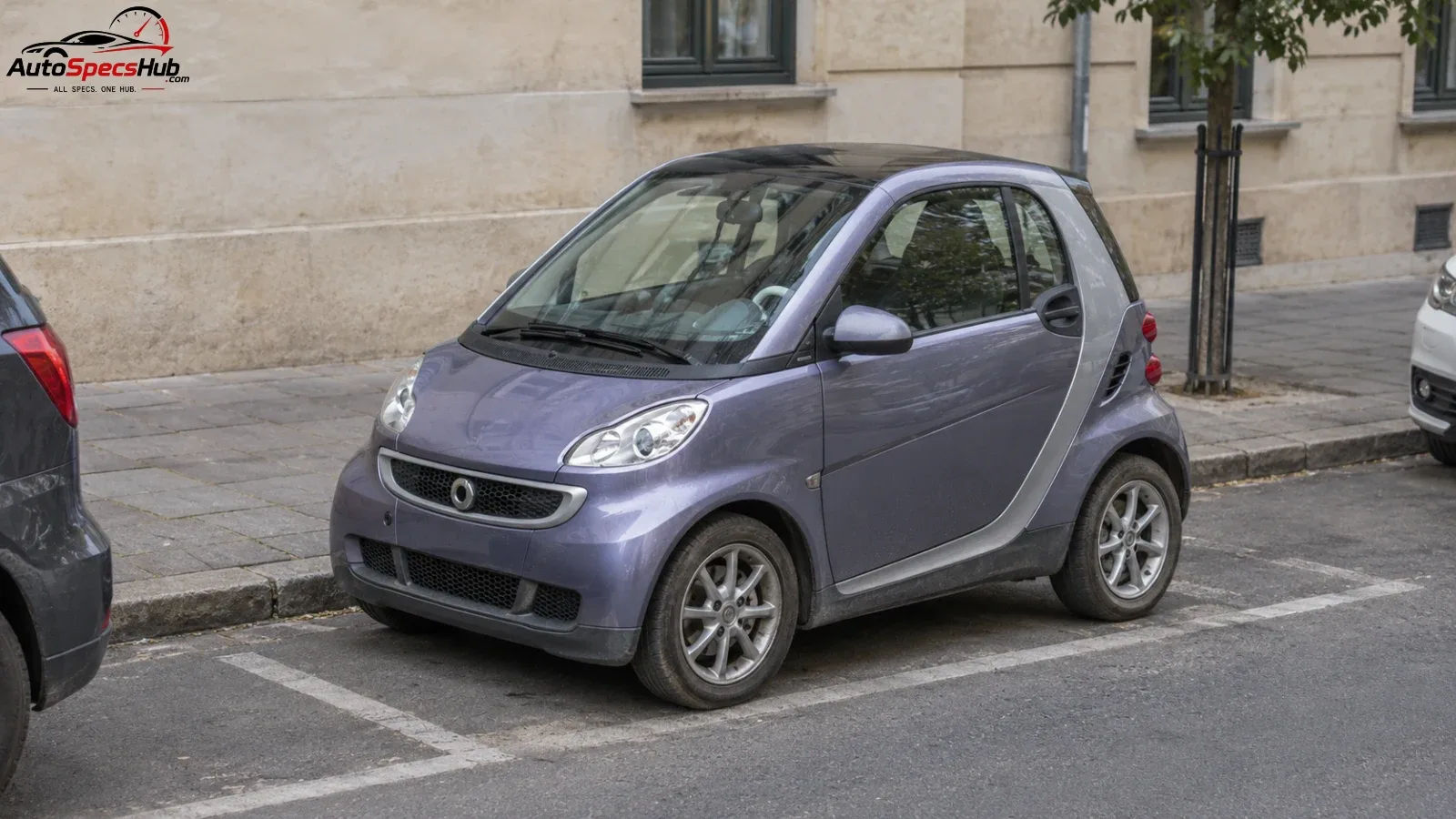
A Smart fortwo weighs between about 1,800 and 2,400 pounds, depending on the year and what powers it. For perspective, the Mercedes C-Class that the Insurance Institute for Highway Safety crash-tested a Smart against in 2009 weighed nearly twice as much.
Smart car weight is also a number that gets quoted inconsistently online. For the same model year, published figures can differ by more than 100 pounds, so this guide explains where the numbers come from and which ones to trust.
Here's what each Smart fortwo weighs, why it varies, and how to find the figure for the car in front of you.
How Much Does a Smart Car Weigh?
Smart sold the fortwo in the US from the 2008 model year through 2019, so every Smart you can buy here is one of these. The four-seat Forfour was never sold in the US.
Smart fortwo | US model years | Curb weight (approx.) | In kilograms |
|---|---|---|---|
Gas, second generation | 2008 to 2015 | 1,800 to 1,900 lbs | 815 to 865 kg |
Electric drive, second generation | 2013 to 2017 | 2,094 to 2,138 lbs | 950 to 970 kg |
Gas, third generation | 2016 to 2019 | About 2,050 lbs | About 930 kg |
Electric, third generation | 2018 to 2019 | 2,363 to 2,383 lbs | 1,070 to 1,080 kg |
Weights vary by body style, trim, and options, so treat these as ranges. News coverage of the 2009 IIHS crash tests put the gas coupe at 1,808 pounds.
Why Published Smart Car Weights Don't Match
If you've compared a few websites, you've probably seen conflicting numbers. There are real reasons for that:
Body style. The cabriolet weighs a little more than the coupe, and some sites mix the two.
Powertrain. Electric models weigh more than gas ones, and some tables blend them under one model name.
Different definitions. Curb weight is the car with standard equipment and fluids but no driver, passengers, or cargo. Gross vehicle weight rating (GVWR) is the maximum the car can weigh fully loaded. Mixing them up makes a Smart look far heavier.
Messy records. One database lists 1,830 pounds for 2008 to 2011, then 1,698 pounds for 2012 and 2013, then 1,881 and 1,896 for 2014 and 2015. That looks more like inconsistent records than real design changes.
To find the weight of a specific car, check the owner's manual specifications first. The door jamb sticker shows GVWR, not curb weight. For a real-world number, drive it onto a certified public scale.
Why Does the Electric Smart Weigh More?
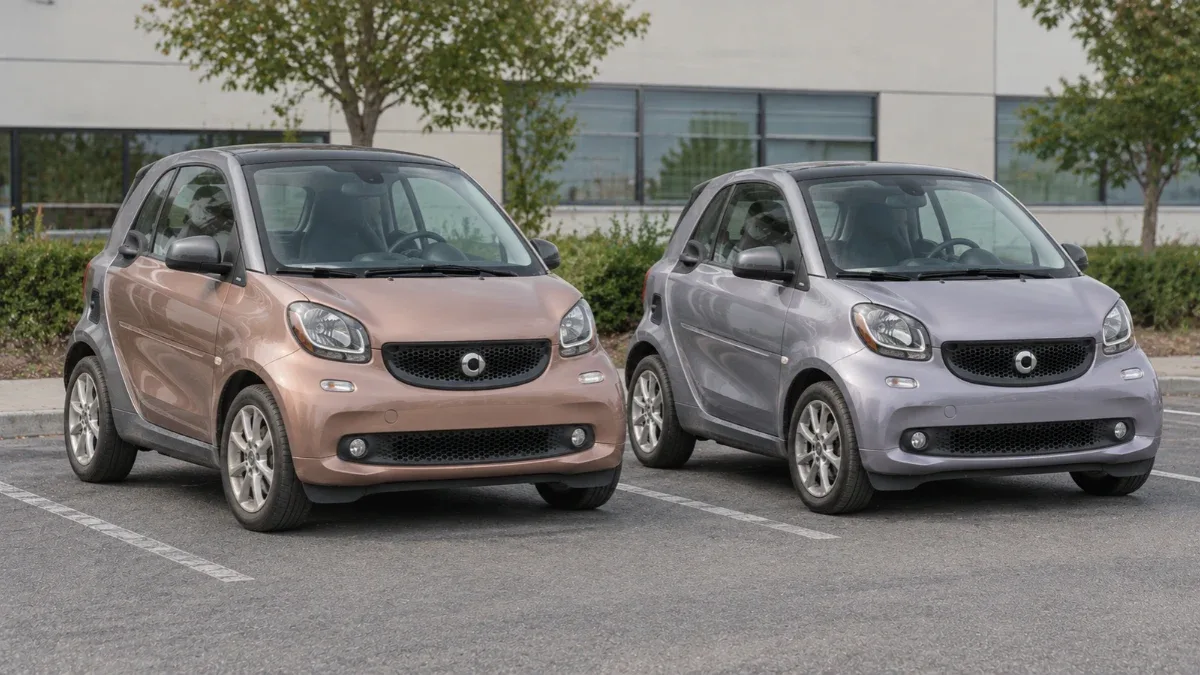
The electric Smart is roughly 250 to 330 pounds heavier than its gas twin, mostly because of the battery pack. The second-generation electric drive weighs about 2,100 pounds, against 1,800 to 1,900 for the gas car. The third-generation electric weighs about 2,360 to 2,380, against around 2,050 for the gas version.
Electric and gas versions share the same length and wheelbase: about 106 inches long on a 73.6-inch wheelbase.
The extra weight also puts more load on the tires, which is one reason tire care gets its own section in the electric car maintenance guide.
Does Smart Car Weight Affect Safety?
The best-known crash tests were run on the 2008 and 2009 models. The IIHS gave the 2008 Smart fortwo its top "Good" rating in front and side tests, and in 2009 it rated the roof strength "Good," which Smart credits to its reinforced steel Tridion safety cell.
Later in 2009, the IIHS ran a 40 mph frontal offset crash between a Smart and a Mercedes C-Class. The C-Class earned "Good" and the Smart earned "Poor." The Smart weighed 1,808 pounds, and the C-Class nearly twice that. The IIHS said minicars do a comparatively poor job protecting people in crashes with larger vehicles because they're smaller and lighter, while Smart called the test a rare and extreme scenario.
The IIHS has long said its frontal ratings only compare vehicles of similar size and weight. In practice, a Smart protects its occupants well in barrier tests, but weight still matters when it meets a much heavier vehicle.
What Light Weight Means in Daily Driving
Weight is a big reason the Smart is so efficient and easy to park. A 2008 fortwo was rated at 33 mpg in the city and 41 mpg on the highway, and at about 106 inches long, it's easy to park in tight spots.
The tradeoff is how a light car feels at speed. Small, light cars tend to react more to crosswinds and bumps than heavier ones, so a highway test drive is worth doing before you buy.
Buying a Used Smart? Check the Weight and the Rest
Smart stopped selling the fortwo in the US after 2019, so every one you'll find is used. The weight difference between model years is small, but the gap between gas and electric is bigger, and it comes with different ownership costs.
Before you commit, run through a used car inspection checklist.
Mileage matters too, and what counts as good mileage for a used car depends on its age and how it was driven.
FAQs
How much does a Smart car weigh in kilograms?
Most US Smart fortwos weigh between about 815 and 1,080 kilograms. The gas cars sit at the lower end, and the electric models at the top.
Does the Smart cabriolet weigh more than the coupe?
Yes, by roughly 20 to 45 pounds, depending on the year and powertrain.
How big is a Smart fortwo?
About 106 inches, or 8.9 feet, long. Width is about 61 inches through 2015 and 65 inches from 2016.
Is the Smart fortwo still sold in the US?
No. US sales ended after the 2019 model year. Smart's newer electric models are sold in other markets.
Find Your Smart's Number, Then Trust It
Smart car weight depends on the year, body style, and whether the car runs on gas or electricity: roughly 1,800 to 2,050 pounds for the gas cars, and about 2,100 to 2,380 for the electric ones.
For your own car, use the owner's manual figure or a real scale reading, and be wary of sites that blend generations together.